

Every hotelier has seen the sad version: a bowl of fruit going soft on the desk, a printed card with the guest's name spelled wrong, delivered to a room the guest reached before the amenity did. The welcome amenity is one of the most visible gestures in luxury hospitality, and one of the easiest to get wrong — because it is treated as a product to be placed rather than a message to be delivered.
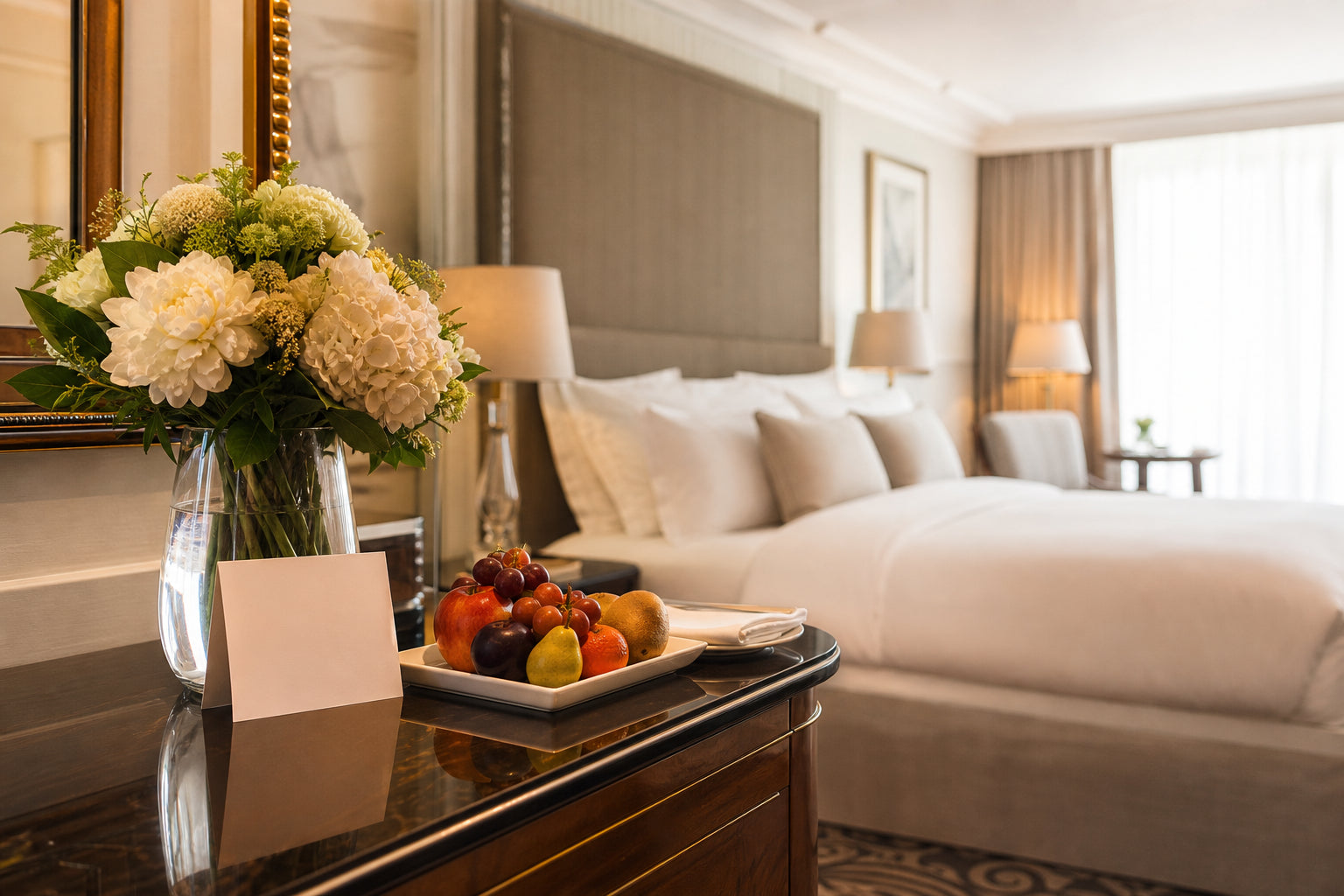
Done well, a welcome amenity tells an arriving guest three things in the first thirty seconds: we knew you were coming, we know something about you, and we took trouble. That message is worth far more than the amenity's cost. This guide covers how to tier welcome amenities sensibly, how to personalise without guesswork, and the operational discipline — timing, room readiness, follow-through — that determines whether the gesture lands.
What a welcome amenity is actually for
Strip away the chocolate and the flowers and the welcome amenity has one job: to convert an anonymous transaction into a personal relationship at the exact moment the guest is forming their first impression. Arrival is the emotional peak of the stay — the guest is alert, evaluating, often tired from travel — and a considered welcome lands harder in that window than the same gesture would at any other point.
This is why generic amenities underperform. A standard-issue fruit bowl in every suite says "this is what suites get"; it is a room feature, not a welcome. The same budget spent on something that references the guest — the reason for their visit, a preference from a previous stay, a note that mentions their anniversary — says "this is what you get," and that is a different category of message entirely.
It follows that the card matters more than the gift. A genuinely handwritten note from the general manager or head of housekeeping, with the guest's name right and a specific detail included, will be photographed and remembered long after the chocolates are eaten. Get the note wrong — misspelled name, wrong occasion, obviously printed signature — and the amenity actively damages the impression it was meant to build.
Tiering: matching the gesture to the guest
Not every VIP is the same kind of VIP, and a single amenity standard wastes money at one end while underwhelming at the other. Most properties are well served by three or four defined tiers, agreed between front office, food and beverage and housekeeping, so that everyone knows exactly what each level involves:
- Recognition tier — returning guests, loyalty members, long-stay corporates. A handwritten card and a modest, well-presented touch: local biscuits, a small bottle of still and sparkling water beyond the standard offering.
- Occasion tier — anniversaries, birthdays, honeymoons flagged at booking. Something that references the occasion directly: a small cake, sparkling wine where appropriate, room styling touches.
- Premium tier — suite bookings, high-value repeat guests, influential visitors. A fuller presentation: quality local produce, fresh flowers, a note from the general manager, preferences pre-loaded from the profile.
- Bespoke tier — genuine top-of-house arrivals. No standard kit at all; the amenity is decided per guest, which is the point.
Tiering is not meanness — it is what makes generosity sustainable. A property that defines its tiers can deliver them consistently every day of the year, which beats an undefined "do something nice" culture that produces brilliance on quiet Tuesdays and nothing during a full house.
Personalisation without guesswork
Personalisation fails when it relies on improvisation at 2pm on arrival day. It succeeds when it is fed by information gathered systematically:
- Booking data. Occasion fields, special requests and rate codes tell you why the guest is coming before anyone has spoken to them.
- Guest history. Previous stays are a goldmine: the pillow they requested, the wine they ordered, the allergy they mentioned. A profile note that captures these turns the second stay into the relationship.
- Pre-arrival contact. A short, warm pre-arrival email asking whether the property can prepare anything is both service and intelligence-gathering.
- Dietary care. Always check allergies and preferences before sending food or drink. An alcohol amenity for a non-drinker, or nuts for an allergic guest, is worse than nothing at all.
One caution: personalisation should feel attentive, not surveilled. Referencing what the guest told you or did as your guest is warm; referencing what you found on their social media is unsettling. The line is simple — use what they gave you.
The room does half the work
A welcome amenity placed in an unprepared room is a bouquet on an unmade bed. The gesture only reads as luxury when everything around it agrees, and VIP room preparation deserves its own checklist ahead of the amenity drop:
- The minibar stocked, chilled and clean — and, where the guest's preferences are known, adjusted to them. A quiet, well-presented minibar is part of the welcome; a warm or half-empty one contradicts it.
- The hospitality tray immaculate: descaled kettle, matched cups, fresh supplies. If the amenity includes perishables, the tray is where guests will look for cutlery and glasses.
- Appliances checked — hair dryer present and working, safe open and reset, iron and board neat. VIP arrivals are precisely when a missing hair dryer becomes a story.
- Temperature and lighting set for arrival, curtains arranged, bathroom finished to inspection standard.
Properties that take VIP arrivals seriously fold the amenity into a single room-readiness inspection rather than treating it as a separate delivery. Reliable, consistent in-room equipment — the sort of kit in Roomwell's guest-room collection, from silent minibars to safes and hospitality trays — is what lets housekeeping sign a VIP room off quickly and with confidence.
Timing and follow-through
The operational rules are unglamorous and decisive:
- Before the guest, always. An amenity delivered after arrival is an interruption; delivered before, it is a welcome. Front office must flag VIP arrivals on the day sheet with expected arrival times, and the amenity should be placed at final room inspection.
- Perishables late, not early. Fresh food and ice-dependent items go in as close to arrival as the schedule allows. The wilting fruit bowl is almost always a timing failure, not a product failure.
- One owner. A named person per shift owns VIP amenities end to end — the brief, the placement, the check. Shared responsibility is how cards go out with the wrong name.
- Close the loop. A brief mention at check-in ("I hope you found everything in the room to your liking") invites the guest to acknowledge the gesture, and any preference revealed during the stay goes straight into the profile for next time.
A gesture that compounds
The welcome amenity is a small line in the budget and a large line in the guest's memory. Tier it so it is sustainable, personalise it from information the guest actually gave you, deliver it into a room that has been genuinely prepared, and write the card as if the guest will keep it — because the best ones do. Do this consistently and the amenity stops being a cost of doing luxury business and becomes one of the cheapest loyalty tools the property owns.
Roomwell supplies the guest-room equipment behind a confident VIP welcome — minibars, kettles, safes, hair dryers and hospitality accessories — to hotels across the UK. Browse the range in our Roomwell products collection, or contact our team to specify rooms that are always ready for the guests who matter most.