

Ask ten guests what they expect to find in a hotel room and you will get a remarkably consistent list: a comfortable bed, a kettle, a decent shower, somewhere to hang clothes, working Wi-Fi. Ask ten operators what their rooms actually contain, and the answers vary far more than they should. Somewhere between guest expectation and room reality sits the brand standard — the documented, auditable list of what every room must provide — and it is one of the most useful tools a hotel business can maintain.
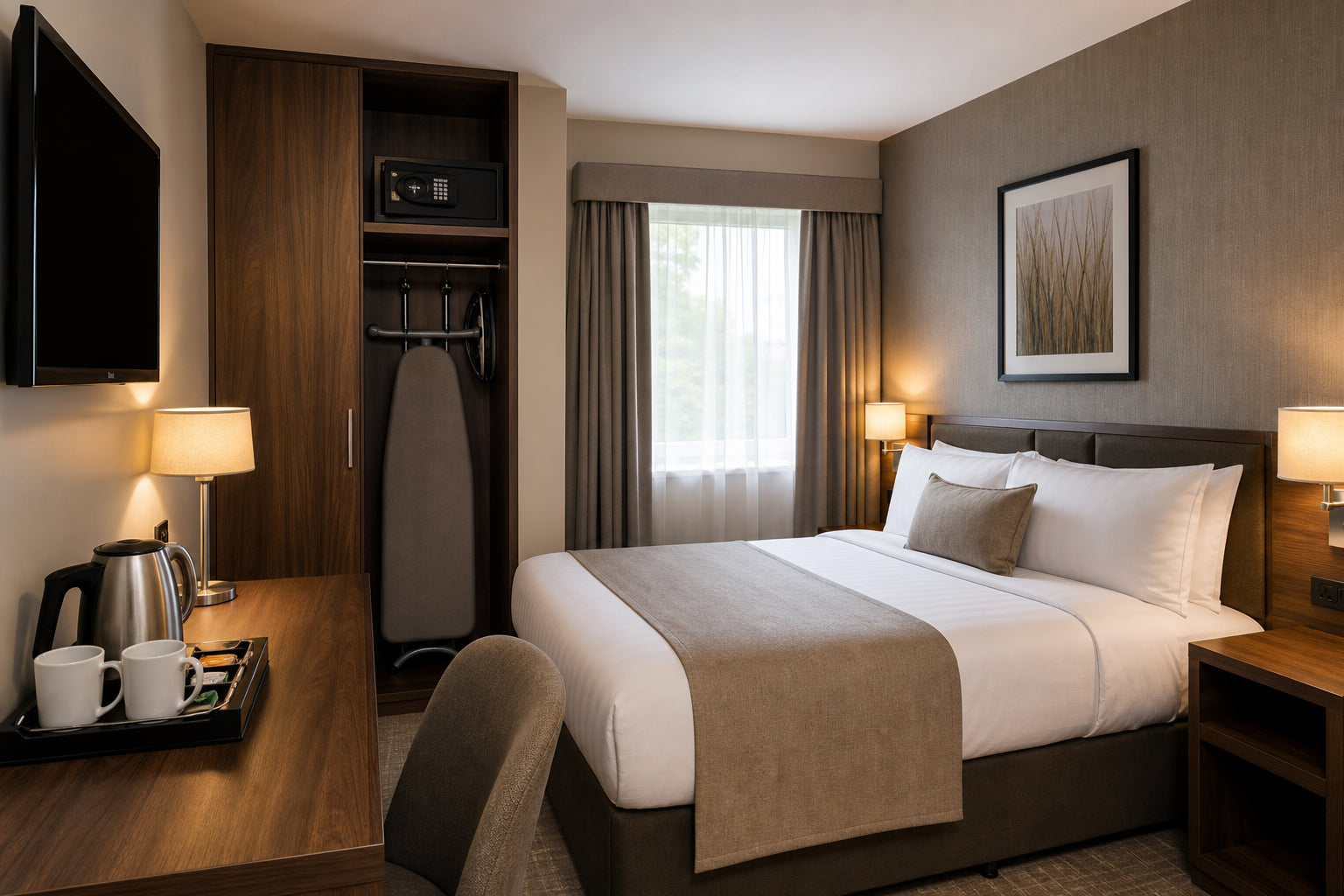
This guide walks through the amenities UK guests now treat as standard, room area by room area, and offers a practical way to separate genuine brand standards from nice-to-haves. The aim is not to make every property identical, but to make every room in your property predictable — because predictability is what guests read as quality, and what housekeeping needs to work efficiently.
Guests do not judge a room against a star rating; they judge it against the last few rooms they stayed in. That means the baseline is always moving, and it means gaps are noticed immediately. A missing hair dryer or an absent ironing board is not a small omission to the guest who needs it at 7am — it is a phone call to reception, a delay, and often a line in a review.
A written standard protects against exactly this. When the amenity list is documented per room type, three things follow:
- Housekeeping can audit rooms quickly. A checklist either passes or it does not; there is no debate about what "properly set up" means.
- Procurement becomes simpler and cheaper. Standardised items mean fewer product lines, easier reordering and consistent spares.
- The guest experience stops depending on which room they were given. Room 12 and room 31 deliver the same stay.
With that in mind, here is what the standard should cover.
The bed and everything around it
The bed is the product. Everything else in the room supports it, and guests forgive very little here. The expectation in the UK market is a supportive mattress in good condition, protected by a washable mattress protector, dressed in clean white linen with enough pillows for the room's occupancy — typically two per guest, ideally with a mix of firmness.
Around the bed, the standard should specify:
- Bedside surfaces on both sides of a double, each with reachable lighting and, increasingly, power or USB sockets within arm's reach.
- Bedside lighting that can be controlled from the bed. A guest should never have to cross a dark room to turn off the last light.
- Blackout capability — lined curtains or blinds that actually meet in the middle. Few things generate complaints as reliably as a room that will not go dark.
- Spare pillow and blanket, cleanly stored in the wardrobe, so a cold or restless guest is not waiting on housekeeping at midnight.
Linen condition deserves its own line in the standard: no greying, no pilling, no stubborn stains that survived the laundry. Guests read tired linen as a tired hotel, whatever the mattress underneath is like.
The hospitality tray: the most-used amenity in the room
In the UK, tea and coffee facilities in the room are not optional at any tier of the market. The kettle is often the first thing a guest uses after arriving and the first thing they use in the morning, which gives the hospitality tray an outsized influence on how the whole room is judged.
A brand-standard tray should include:
- A reliable cordless kettle, descaled on a schedule — hard water is the norm across much of the UK and limescale is the fastest way to ruin the first cup of the day.
- Matched cups or mugs appropriate to the property's tier, with teaspoons.
- Tea, coffee, sugar and a milk solution, presented tidily and replenished at every service.
- A wipeable tray that contains everything, so housekeeping can reset it quickly and consistently.
Because the tray is handled by almost every guest on almost every stay, it is worth specifying properly rather than assembling from whatever is available. Consistent kettles and tray items across the estate also simplify spares and replacement enormously.
Bathroom basics guests will not compromise on
The bathroom is the second place guests test a room, and the standard here is about completeness and condition rather than luxury. Every room should provide:
- Towels in the right quantity and condition — at minimum a bath towel and hand towel per guest, plus a bath mat, all soft, white and free of fraying or grey wash-out.
- Toiletries appropriate to the tier. Soap and shampoo are the floor; body wash and conditioner are expected in most mid-market properties, whether as individual items or wall-mounted dispensers. Whatever the format, dispensers must be full and clean.
- Toilet paper with a spare roll visible. Guests should never have to wonder.
- A hair dryer — stored where guests can find it (drawer or wardrobe, ideally in a pouch) and tested as part of room checks. It is one of the most requested items at reception when missing.
- Tissues, a sanitary disposal solution, and a waste bin — small items, but their absence is conspicuous.
- A mirror with decent lighting, and a shaver socket where the building allows.
Ventilation and drainage sit alongside amenities here: an extractor that works and a shower that drains are part of the guest's mental checklist even if they are not on the housekeeping trolley.
Clothing care, security and in-room storage
Business guests and leisure guests converge on the same practical needs: somewhere to put clothes, a way to deal with creases, and a place to secure valuables.
- Wardrobe with proper hangers — enough of them, including trouser-bar or clip hangers, and not the flimsy variety that guests interpret as cost-cutting.
- Iron and ironing board in every room, or at minimum available on request with the room signage saying so clearly. For rooms targeting business travel, in-room provision is the expectation. The board should have an intact cover and the iron a clean soleplate — a scorched iron is worse than no iron.
- An in-room safe, sized to take a laptop, where the brand standard calls for it. Where safes are not provided, reception storage should be offered and signposted. Batteries and override procedures belong in the maintenance schedule, not in a guest complaint.
- Luggage rack or bench — a small item that saves beds and furniture from suitcases and signals a room designed by someone who has actually travelled.
Where the property's positioning supports it, a minibar or guest fridge earns its place — particularly for longer stays, family rooms and warmer months, when guests want somewhere for milk, medication or their own purchases. A quiet-running unit matters more than a stocked one; an audible compressor in a small room will cost you sleep-quality scores. Many operators now provide an empty fridge as standard and treat stocked minibars as a premium-tier decision.
Comfort, connectivity and the small essentials
The remaining standards are the ones guests only mention when they fail:
- Wi-Fi that works, free, without friction. Complicated log-ins and per-device limits generate more irritation than almost any physical amenity. Connectivity is now judged as part of the room, not as a service.
- A television with the mainstream channels tuned, a working remote with fresh batteries, and ideally straightforward casting or HDMI access for guests who bring their own content.
- Layered lighting — ceiling, task and bedside — with every bulb working. A single dead bulb undermines an otherwise perfect room check.
- Accessible power sockets at the desk and bedside. Guests should not be unplugging lamps to charge phones.
- Heating or cooling the guest can control, with clear instructions if the controls are not self-evident.
- Waste bins — one in the bedroom, one in the bathroom, both lined and emptied at every service.
- Room information — Wi-Fi details, checkout time, emergency information and how to reach reception, whether printed or on screen.
Brand standards versus nice-to-haves: drawing the line
Not everything belongs in the standard. The test is simple: would a reasonable guest at your price point expect it, and would its absence generate a request or a complaint? If yes, it is a brand standard and every room must have it, every stay, without exception. If it merely delights, it is a nice-to-have — valuable, but deployed deliberately rather than promised universally.
For most UK properties, the standard column includes the bed package, hospitality tray, bathroom basics, hair dryer, iron and board (or clear on-request provision), functioning Wi-Fi and TV, controllable lighting and heating, bins and room information. The nice-to-have column typically holds stocked minibars, coffee machines, robes and slippers, premium toiletry brands, smart-room controls and turndown touches — items that lift a stay but can be tiered by room category rather than mandated estate-wide.
Two rules keep the line honest:
- Never advertise a nice-to-have as a standard. A promised amenity that is missing does more damage than one never offered.
- Review the list annually. Expectations migrate — bedside USB sockets and fuss-free Wi-Fi were once differentiators and are now baseline. Yesterday's nice-to-have becomes today's standard, and the list should move with it.
Once the line is drawn, put it in writing per room type, build it into the housekeeping checklist, and standardise the products behind it so that replacement never quietly erodes the standard.
Roomwell supplies the guest-room amenities behind these standards — kettles and hospitality trays, hair dryers, safes, ironing equipment, minibars and guest fridges, and bins — chosen for reliability under daily hotel use and consistent presentation across an estate. Browse the range in our Roomwell products collection, or contact sales to build an amenity specification that holds up in every room, every night.