

Ask guests what luxury feels like and they will describe the bed, the bathroom, the view. But ask them what ruins a five-star stay and one answer dominates: noise. A corridor door slamming at midnight, a neighbour's television through the wall, a fridge compressor cycling on at 3am. Quiet is the invisible amenity — guests never compliment it directly, yet its absence overrides everything else the room does well. No thread count survives a sleepless night.
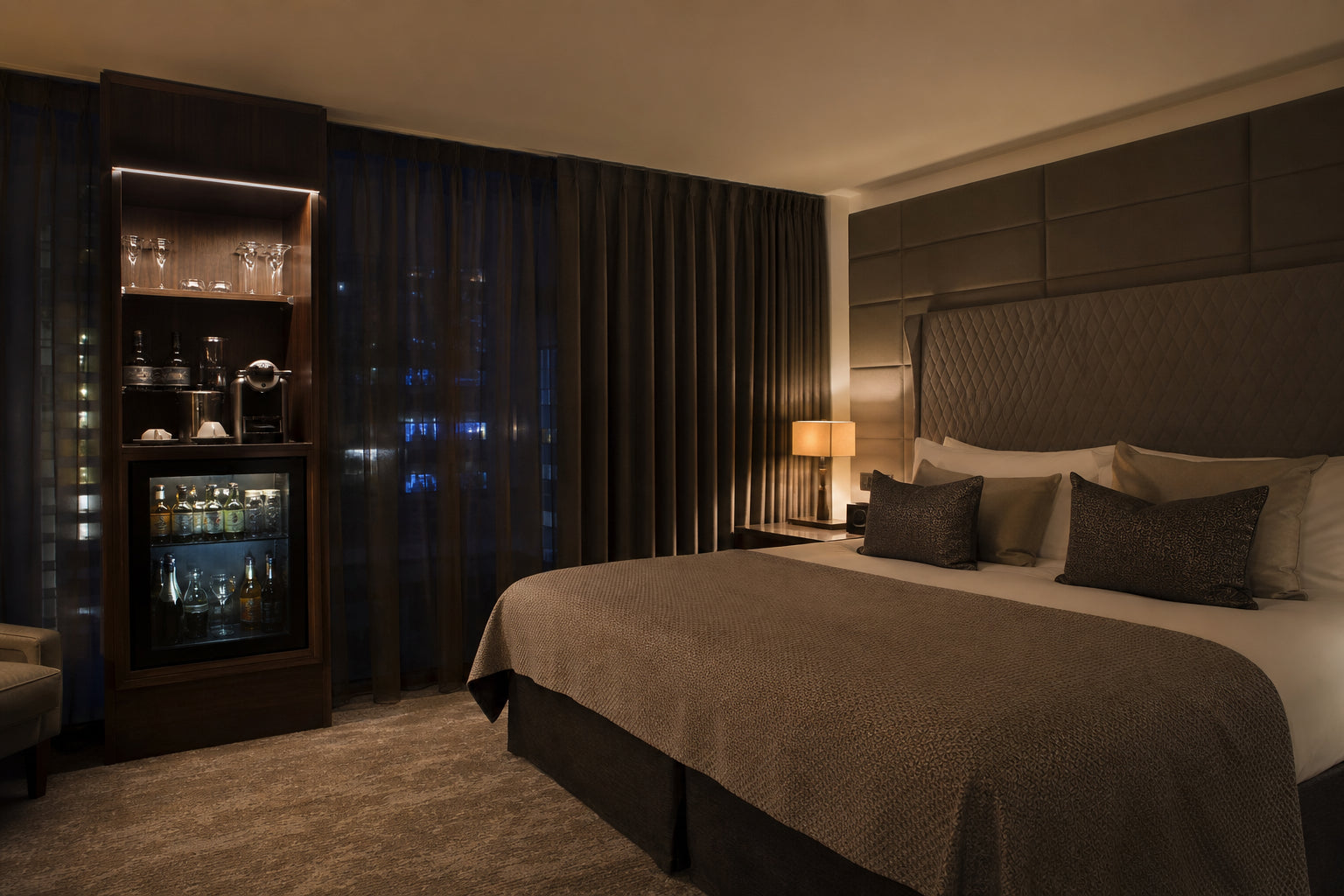
Privacy is quiet's twin. A guest who can hear the corridor assumes the corridor can hear them; a room that feels acoustically porous never feels fully private, whatever the lock and the "do not disturb" light promise. Five-star properties treat both as engineering problems with known solutions. This guide walks through where noise enters a guest room, how top-tier hotels design it out, and the specification decisions — including the often-overlooked minibar — that operators and procurement teams control directly.
Where noise actually gets into a guest room
Guest-room noise comes from four directions, and each needs a different fix:
- The corridor. Voices, luggage trolleys, and above all doors. The room's entrance door is usually the weakest acoustic point in the whole envelope.
- Adjacent rooms. Televisions, conversations and plumbing through party walls — and through interconnecting doors, which are notorious acoustic shortcuts.
- Outside. Traffic, deliveries and street life through glazing, which matters most in the city-centre locations luxury hotels favour.
- Inside the room itself. Air-conditioning units, extractor fans, plumbing runs and — the classic offender — the minibar compressor. This last category is the most insidious because the guest cannot escape it by closing anything.
The distinction between airborne noise (voices, TV) and structure-borne noise (footsteps above, vibrating equipment) matters too. Mass and sealing deal with the first; isolation and decoupling deal with the second. Five-star acoustic design layers both.
How 5-star properties engineer the envelope
The construction-side toolkit is well established, and it is worth operators understanding it even where the work sits with contractors:
- Doors with mass and seals. Solid-core entrance doors with full perimeter seals and drop-down thresholds, plus soft-close hardware so one guest's arrival is not the whole floor's alarm clock. Interconnecting doors are doubled, with a lobby of air between the leaves.
- Party walls built for separation. Independent or staggered stud walls, multiple layers of acoustic board, and insulation in the cavity — with sockets and switches offset rather than back-to-back, since a shared socket box is a hole in an otherwise good wall.
- Secondary or acoustic glazing. Laminated glass and wider cavities to cut street noise, paired with heavy curtains that add absorption as well as blackout.
- Layout as a buffer. Wardrobes, bathrooms and entrance lobbies placed between the corridor and the bed, so the sleeping area sits in the quietest corner of the plan. It is the cheapest acoustic measure available — it costs a floor plan, not a budget line.
- Soft surfaces inside the room. Carpet, upholstered headboards, padded walls and full-length curtains do little to stop noise entering, but they stop the room itself sounding hard and echoey, which changes how private it feels.
The equipment inside the room: the noise you chose
Here is the uncomfortable truth for procurement: after the building has done its job, the remaining night-time noise in a well-built room is usually equipment the hotel itself specified. And the single most common culprit is the minibar.
A conventional compressor minibar cools by running a motor, and that motor cycles on and off through the night. In a busy daytime room nobody notices; in a silent, well-sealed 5-star bedroom at 3am, the click of a compressor starting and the hum that follows are exactly the kind of intermittent noise the sleeping brain is wired to register. The better the soundproofing, the more exposed the minibar becomes — the hotel has removed every competing sound and left the fridge performing solo.
This is why luxury properties increasingly specify absorption minibars. Absorption cooling has no compressor and no moving parts in the cooling circuit; it runs silently, full stop. For a guest room where the minibar often sits within a few metres of the pillow — inside a joinery unit under the TV, or beside the bed in a studio suite — that difference is not a refinement, it is the difference between a quiet room and a noise complaint. The specification points that matter:
- Silent absorption cooling rather than compressor cycling, wherever the unit shares a space with a sleeping guest.
- Solid, rattle-free installation. Even a silent unit can transmit vibration if shelving or bottles are loose; a snug joinery fit and sensible stocking layout finish the job.
- Discreet lighting and door action. Soft interior lighting and a quiet, well-damped door keep the midnight raid from waking a partner — privacy within the room matters too.
The same audit applies to everything else that runs at night: fan-coil units on their lowest setting, bathroom extractors on sensible overruns, and kettles and other appliances that should be silent when off. But the minibar is the item guests sleep next to, and it is the one where a straightforward procurement decision eliminates the problem entirely.
Privacy is more than acoustics
Guests experience privacy as a whole, and sound is only part of it. A five-star privacy standard also covers:
- Visual privacy. Sheer and blackout layers that let guests choose daylight without exposure; no sightlines from the corridor when the door opens; bathroom glazing that frosts or screens properly.
- Light discipline. Blackout that actually blacks out, and standby LEDs specified or masked so the room can go genuinely dark — a glowing appliance is the visual equivalent of a humming one.
- Service protocols. Knock-and-wait standards, respected do-not-disturb status, and housekeeping scheduled around the guest rather than through them.
- Secure storage. A reliable in-room safe underwrites the feeling that the room is the guest's own territory while they are out of it.
These reinforce each other. A guest who trusts the room's quiet, darkness and security relaxes into the stay; a guest who has noticed one leak — sound, light or service — starts noticing all of them.
An operator's quiet-room checklist
For properties auditing existing stock rather than building new, the highest-value checks are:
- Stand in each room type with the door closed at a quiet hour and listen for two minutes. What you hear, guests hear all night.
- Check entrance-door seals and closers; replace worn seals and adjust slamming closers — the cheapest acoustic win in the building.
- Identify every room where a compressor minibar sits within earshot of the bed, and prioritise those rooms for silent absorption replacements.
- Fit soft-close hardware to wardrobe doors, drawers and toilet seats; night-time noise inside the room disturbs the second guest.
- Walk the room in full darkness and log every standby light; mask or re-specify the offenders.
- Review housekeeping and maintenance schedules against occupancy patterns so vacuum cleaners and drilling never share a wall with a sleeping guest.
None of these requires a refurbishment budget, and together they move a room a long way towards the five-star baseline: a guest who closes the door and hears nothing they did not choose to hear.
Quiet is a specification, not an accident
The quietest rooms in UK hospitality are not lucky; they are specified. Structure keeps the world out, layout keeps the corridor away from the pillow, and disciplined procurement makes sure the hotel never installs the noise itself. Of all the decisions on that list, the minibar is the simplest to get right — choose silence, install it well, and the guest sleeps through the one appliance that shares their bedroom.
Quick answer: Quiet is the luxury guests pay for but never see. From door seals to the hum of the minibar, here is how 5-star hotels engineer sound and privacy into the guest room — and where budgets are best spent.
Benefits
- Protects guest sleep with quieter cooling in the room.
- Supports higher review scores linked to rest and comfort.
- Gives operators a clear specification choice (absorption vs compressor).
- Improves perceived luxury when stock presentation is clean and chilled.
Features
- Quiet cooling technology suited to bedside or cabinet placement.
- Solid or glass door options for brand presentation standards.
- Capacities matched to room type rather than one estate-wide default.
- Hotel-grade build for continuous hospitality duty cycles.
Frequently asked questions
Why do silent minibars matter for hotel reviews?
Because noise at night is a common complaint. A quieter unit protects sleep and reduces negative comments about humming fridges.
Is absorption better than compressor for guest rooms?
For most UK guest rooms, absorption is preferred for near-silent operation. Compressor units suit warmer loads or non-sleep spaces.
What should operators check when installing a minibar?
Ventilation clearances, level fit, door finish, capacity by room type, and that the unit does not rattle against cabinetry.
Do guests expect a stocked minibar in every hotel?
Expectations rise with star level. Mid-scale rooms often use an empty fridge; luxury rooms more often stock a quiet chilled minibar.
Roomwell supplies silent absorption minibars and quiet-room guest equipment — safes, kettles, hair dryers and more — to hotels across the UK. Browse the Roomwell product range, or contact our team to specify guest rooms that protect sleep and privacy to a five-star standard.