

There is a moment familiar to anyone who travels often: standing in a beautiful hotel room at midnight, jabbing at a touch panel, trying to work out which combination of icons turns off the last light. Smart room technology promised effortless luxury; delivered badly, it produces the opposite — a room that makes intelligent adults feel foolish.
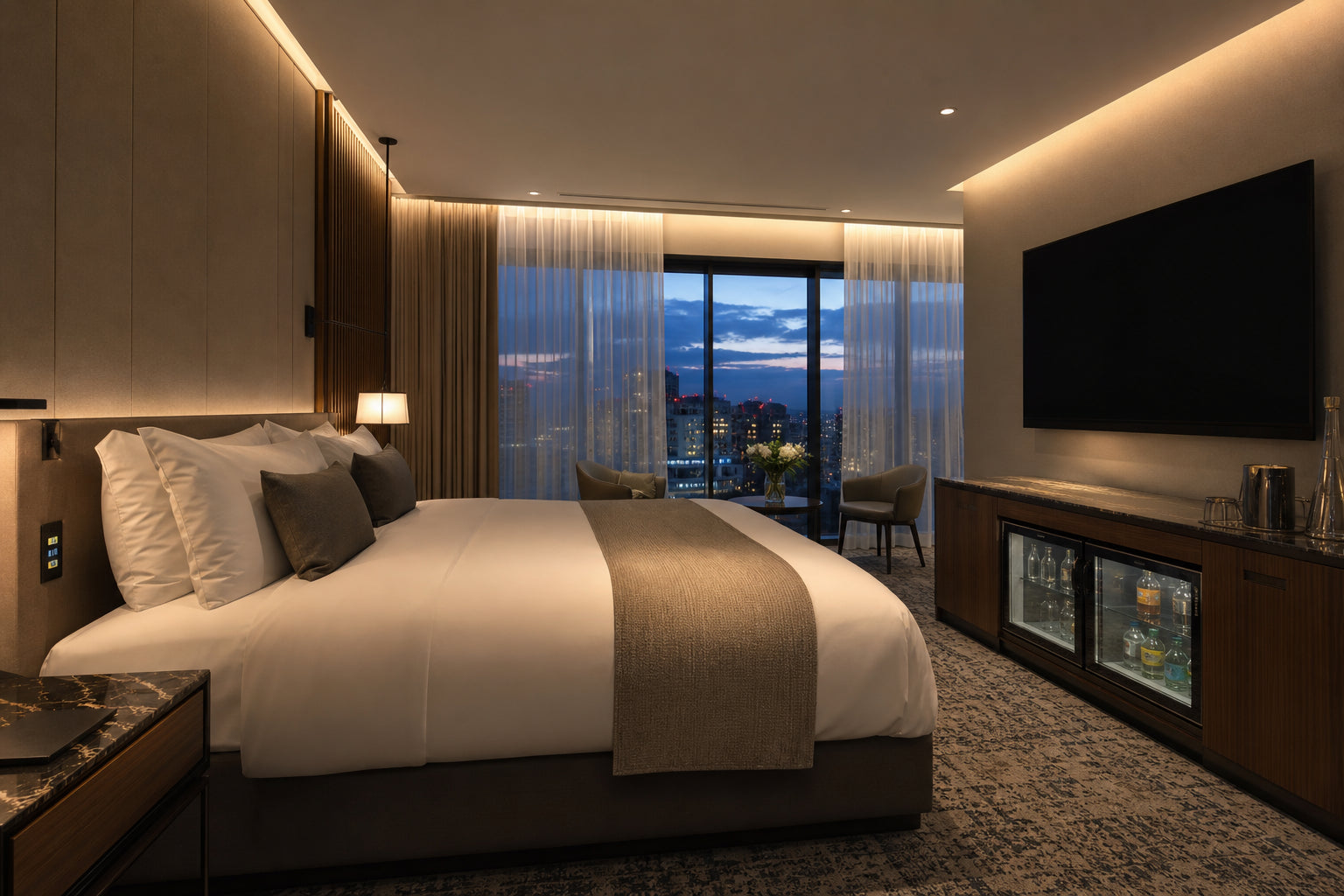
Yet when it is done well, in-room technology is one of the strongest differentiators in luxury hospitality. Lighting that eases itself down for the evening, a room already at the guest's preferred temperature, entertainment that connects to their own devices in seconds — these register as genuine hospitality, not gadgetry. The difference between the two outcomes is rarely the technology itself. It is the judgement applied in choosing it, integrating it and maintaining it. This guide sets out where smart technology earns its place in a luxury guest room, and the principles that keep it on the right side of the line.
The first principle: technology should remove effort, not add it
Every piece of in-room technology should pass a simple test: does it make something the guest wants to do easier than the conventional alternative? A tablet that takes four taps to turn off a lamp fails against a bedside switch. An app-controlled thermostat fails against a clear dial if the guest has to download anything first.
Luxury guests are diverse — seasoned business travellers, older couples, families, international visitors on unfamiliar systems — and the room must work intuitively for all of them, tired, jetlagged and without a manual. In practice that means:
- Every smart function needs an obvious physical fallback: real switches by the bed and door, a visible thermostat control, a kettle that just boils.
- Nothing essential — lights, curtains, temperature, television — should require the guest's own phone or an app download.
- Controls should be labelled in plain language and icons, consistent in every room, and reachable from where guests actually are: the bed, the desk, the door.
Lighting and climate: the highest-return investments
If a property invests in only two smart systems, lighting and climate deliver the most guest-perceived value. Scene-based lighting — a handful of clearly named settings such as bright, relaxed, reading and night — lets guests shape the room's mood in one press, while a master-off by the bed solves the midnight light hunt permanently. A low-level night path to the bathroom, triggered gently rather than floodlighting the room, is the kind of detail guests mention in reviews without knowing what to call it.
Climate control earns its keep both in comfort and in operations. Guests get quiet, responsive, individually adjustable heating and cooling; the property gains occupancy-aware setback that trims energy use in empty rooms without ever letting a guest walk into a cold one. In an era of high energy costs and sustainability commitments, this is one of the few technologies that pays for itself twice — once in guest comfort, once on the utilities bill.
Entertainment and connectivity: meet guests where they are
The battle for in-room entertainment is over: guests bring their own content. The luxury standard is no longer a large channel list but frictionless access to the guest's own services — casting from their device to a large, high-quality screen, secure and isolated from other rooms, wiped of any personal data automatically at checkout.
Around that core, the essentials are:
- Wi-Fi that never becomes a topic. Fast, free, seamless across the property, and capable of handling a family's worth of devices per room. In luxury hospitality, guests only mention Wi-Fi when it fails.
- Power where life happens. Mains and USB-C at both bedsides, the desk and the seating area. Wireless charging pads are a welcome refinement; hunting behind furniture for a socket is a five-star failure.
- Bluetooth audio as a simple, universally understood pleasure — far more used than elaborate integrated sound systems.
- Voice assistants only with care. Some guests love them; others are uncomfortable sharing a bedroom with a microphone. If deployed, they must be clearly disclosed, easy to mute physically, and never the only way to control anything.
The quiet layer: appliances still carry the experience
Amid the excitement about connected rooms, it is easy to forget that much of the guest's physical experience still runs through conventional appliances — and that smart ambitions collapse if this layer disappoints. The most sophisticated lighting scene cannot compensate for a minibar compressor rattling through the night, and no app improves a slow, scaled kettle.
In a technology-led room, the appliance layer should be specified to match:
- Silent minibars — absorption or thermoelectric cooling rather than droning compressors — so the room's engineered calm survives the night. Networked minibar monitoring can add stock alerts and energy management for larger estates.
- Digital safes with straightforward keypads, sized for laptops, supporting the reality that guests now travel with their office in a bag.
- Quality kettles, hair dryers and irons — fast, reliable and standardised across rooms, because guests notice performance, not connectivity, in these items.
- No stray LEDs. Every appliance and device in the sleep zone should be dark at night; a constellation of standby lights undoes blackout curtains.
Operators can align this layer with a smart-room programme using our Roomwell guest-room range, specified for quiet operation and consistent estate-wide performance.
Reliability, privacy and the operational reality
Technology that fails is worse than technology that was never installed, because it breaks a promise the room visibly made. Before any system reaches a guest room, three operational questions need firm answers:
- Who fixes it, and how fast? Smart systems need defined support arrangements, on-site spares for common failures, and a fallback that keeps the room sellable when a controller dies. A room that cannot turn its lights on is out of order, whatever the occupancy forecast says.
- How is guest data handled? Occupancy sensing, viewing history, voice interactions and network logs are all personal data. Systems must be configured for minimal collection, automatic clearing between stays, and compliance with UK data-protection law — and the property should be able to explain its practices plainly if a guest asks.
- Can housekeeping and front office actually run it? Every system adds training load. If a room reset after checkout takes specialist knowledge, the technology has failed operationally regardless of how it demos.
It is also worth remembering how quality assessors and, more importantly, guests experience a room: as ordinary users, without a briefing. UK schemes such as the VisitEngland and AA star ratings assess the guest experience as it is actually delivered — and a confusing control panel delivers confusion, however advanced the system behind it.
A deliberate, guest-first roadmap
The properties that get smart rooms right tend to follow the same sequence: fix the invisible foundations first (Wi-Fi, power, silence), then automate the highest-friction moments (lighting master control, climate), then add refinements (scenes, casting, curtains) — testing each layer with real guests and real housekeeping teams before the next. Technology chosen this way disappears into the experience, which in luxury hospitality is precisely the point: the guest should remember the stay, not the switches.
Quick answer: Smart room technology can elevate a luxury stay or quietly ruin it. Here is how leading hotels choose, deploy and maintain in-room technology that guests actually thank them for.
Benefits
- Reliable in-room tech reduces frustration and call volume.
- Clear controls improve accessibility for all guests.
- Streaming-ready Wi-Fi supports leisure and hybrid work stays.
- Standardised devices simplify training and replacements.
Features
- Stable Wi-Fi with enough capacity for video use.
- Simple TV/streaming setup guests can use without support.
- USB / charging points in sensible bedside locations.
- Optional smart controls that fail gracefully to manual use.
Frequently asked questions
What technology do guests expect in every room?
Fast Wi-Fi, easy TV use and enough charging points near the bed and desk.
Should hotels install complex smart-room systems?
Only if staff can support them and guests can override simply. Reliability beats novelty.
How does tech affect reviews?
Login friction, dead remotes and weak Wi-Fi create outsized negative comments.
What is a practical upgrade path?
Fix Wi-Fi and charging first, then simplify TV experience, then consider automation.
Roomwell supplies the appliance layer that smart luxury rooms are built on — silent minibars, digital safes, kettles, hair dryers and guest-room equipment specified for quiet, reliable estate-wide performance. Browse the range in our Roomwell products collection, or contact our team to specify in-room equipment for your next refurbishment.