

Ask guests what they want from a hotel room and they will list comforts. Watch what they actually do on arrival and a different priority reveals itself: they check the door lock, glance at the window catch, look for the safe, test that things work. Before a guest can enjoy a room, they have to trust it — and trust is built from two families of standards working together: safety standards, which protect the guest, and service standards, which assure the guest that someone competent is looking after everything.
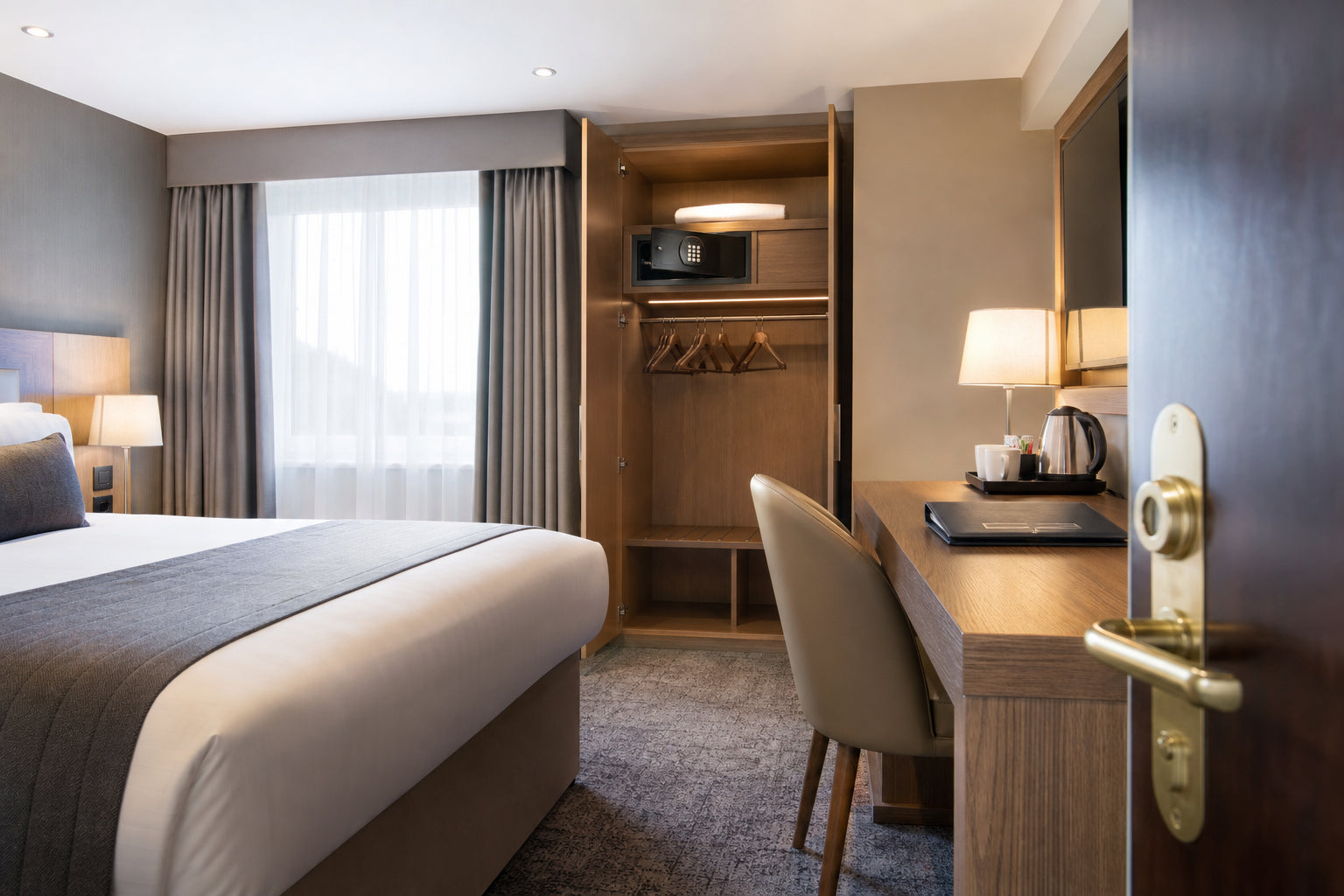
This article treats the two as the connected system they are, and sets out how UK operators build, document and hold both inside the guest room.
Safety standards: the non-negotiable layer
In-room safety spans more territory than operators sometimes credit — it is not just fire provision. A reasonably complete map covers:
- Security of the room itself — door locks in sound working order, self-closing doors that actually close, functioning secondary latches or viewers where fitted, and window restrictors on upper floors.
- Fire and emergency provision — working detection in the room, unobstructed escape information displayed where guests will find it, and furnishings and equipment that meet relevant standards.
- Electrical safety — every appliance the guest touches (kettle, hair dryer, iron, TV, lamps) with intact cables, undamaged plugs and periodic testing appropriate to the property; no scorched sockets, no adaptors daisy-chained behind the desk.
- Safe custody of belongings — an in-room safe that is anchored, functioning, and sized for what guests genuinely want to secure, laptops included.
- Everyday physical safety — secure fittings, stable furniture, trip-free flooring, bathroom surfaces and grab points appropriate to the property, and hot equipment (kettles, irons) supplied with surfaces and storage that keep them stable in use.
Two disciplines make this layer real rather than aspirational. The first is routine checking with named ownership: safety items live on scheduled checklists — some at every turnover, some weekly, some on a maintenance cycle — and each list has an owner. The second is equipment selection: appliances built for hospitality use, with the durability and design margin for daily operation by unfamiliar hands, fail less often and less dangerously than domestic-grade equipment bought on price. Safety, in other words, is partly a procurement decision made long before any checklist is written.
Service standards: the visible half of trust
Service standards define what the guest should experience in the room, every stay, without variation: the condition the room is in at check-in, what it contains, how quickly requests are met, and how problems are handled. Where safety standards protect the guest, service standards prove to the guest that the property is competent — and guests instinctively read one as evidence of the other. A room with a missing kettle and an unemptied bin does not merely disappoint; it makes the guest wonder what else has been skipped.
The core service standards worth writing down for the room:
- The arrival standard — the exact state of a room at handover: cleanliness, presentation, every amenity present, every appliance tested and working.
- The daily service standard — what a stayover service includes, when it happens, and how the guest's own arrangement of the room is respected.
- The request standard — target times for delivering extras: a cot, an ironing board, additional bedding, an adaptor — and where those items are held so the target is achievable.
- The recovery standard — what happens when something in the room fails: how fast the response, who attends, and what the guest is told. A swift, competent recovery frequently earns more goodwill than an incident-free stay.
Where safety and service meet: the equipment layer
The clearest illustration of how the two standards interlock is the room's equipment. Every appliance is simultaneously a service item and a safety item. The kettle is a hospitality gesture and a heat source. The iron is a convenience and a hazard if its cable frays. The hair dryer is a daily essential and an electrical device operated inches from water. The safe is a service to the guest and a security commitment by the house.
Managing that dual identity is straightforward when it is systematised:
- Standardise models across the estate, so testing routines, spares and staff familiarity cover every room identically.
- Function-check at turnover — a fifteen-second check per appliance catches most faults before a guest does.
- Retire, don't nurse — an appliance that fails twice is replaced; repeated repair of guest-facing electricals is a false economy on both the service and safety ledgers.
- Buy hospitality-grade from the start — equipment designed for hotel duty cycles holds both standards far longer than domestic substitutes.
Operators reviewing their rooms against this logic can specify a standardised, hospitality-grade equipment set from the Roomwell products collection — kettles, safes, hair dryers, irons and boards, minibars and room accessories selected for exactly this daily double duty.
Documentation: standards that survive staff change
Both families of standards share the same failure mode: living in people's heads. The property that "has always done it this way" discovers, one resignation at a time, that its standards were actually one person's habits. The remedy is proportionate documentation:
- A written room specification per room type — contents, presentation, appliance set.
- Checklists for turnover, arrival checks and periodic safety inspections, each with a named owner and a record that it happened.
- A simple fault log connecting housekeeping observations to maintenance action, so nothing seen goes unreported and nothing reported goes unfixed.
- Induction material that teaches new starters the standard, not just the tasks.
None of this needs to be bureaucratic. A laminated card on the trolley and a shared log the team actually uses will outperform an elaborate manual nobody opens. The test is continuity: if the head housekeeper left tomorrow, would the rooms be the same in a month?
Holding the line: inspection and honest measurement
Standards decay by increments — a skipped check on a busy Friday, a nursed appliance, a shortcut that becomes a habit. Holding them requires the same machinery for both families: sampled inspection against the written standard, recording of why rooms fail, guest-reported faults treated as system misses rather than bad luck, and a periodic management walk of rooms chosen at random rather than prepared in advance.
The measure that matters most is simple: how often does a guest discover a problem before the property does? Every such discovery — a dead socket, a wobbly kettle, a safe that will not open — represents a checklist that was skipped or a threshold that was set too loose. Driving that number down is the whole practical meaning of "standards."
Trust as the product
Safety and service standards in guest rooms converge on a single output: a guest who stops checking and starts relaxing. That trust is built from unglamorous parts — anchored safes, tested kettles, closed loops between housekeeping and maintenance, written specifications that outlive any individual — but it is the foundation on which every other part of the guest experience stands.
Quick answer: Guests only relax in a room they trust. Safety standards and service standards are how that trust is built — and both come down to specification, routine and equipment that never lets the guest down.
Benefits
- Helps hotels and travellers act on: Guests only relax in a room they trust. Safety standards and service standards are how that trust is built — and both come down to specification, routine and equipment that never lets the guest down.
- Turns vague hospitality advice into practical room-level decisions.
- Supports better guest satisfaction through clearer standards.
- Connects room presentation, appliances and operations in one framework.
Features
- Operator-focused guidance for UK hospitality rooms.
- Clear standards guests can feel on arrival.
- Checklist-style points teams can train against.
- Links between guest comfort and equipment reliability.
Frequently asked questions
What is the key takeaway from “Safety and Service Standards in Hotel Guest Rooms”?
Guests only relax in a room they trust. Safety standards and service standards are how that trust is built — and both come down to specification, routine and equipment that never lets the guest down.
Why do in-room details matter so much?
Because guests judge the whole hotel through sleep, bathroom cleanliness and whether everyday appliances work.
How should hotels prioritise upgrades?
Fix foundations first — bed, bathroom, noise and reliable appliances — before decorative extras.
Where can operators find suitable guest-room equipment?
Browse Roomwell’s hospitality collections or contact the team for specification support.
Roomwell supplies UK hotels with equipment fit for both halves of the promise: in-room safes, kettles, hair dryers, irons and ironing boards, minibars and room accessories specified for hospitality use and estate-wide consistency. Browse the Roomwell range, or contact our team to review the equipment behind your room standards.