

Room service is unlike anything else a hotel does. Every other service happens on the hotel's territory — the restaurant, the bar, the front desk. In-room dining crosses the threshold into the guest's private space, usually when they are tired, hungry or celebrating, and it plays out with no manager watching and no ambience to help. It is service stripped to its essentials: was it easy to order, did it arrive as promised, was it presented with care, and was the evidence taken away afterwards.
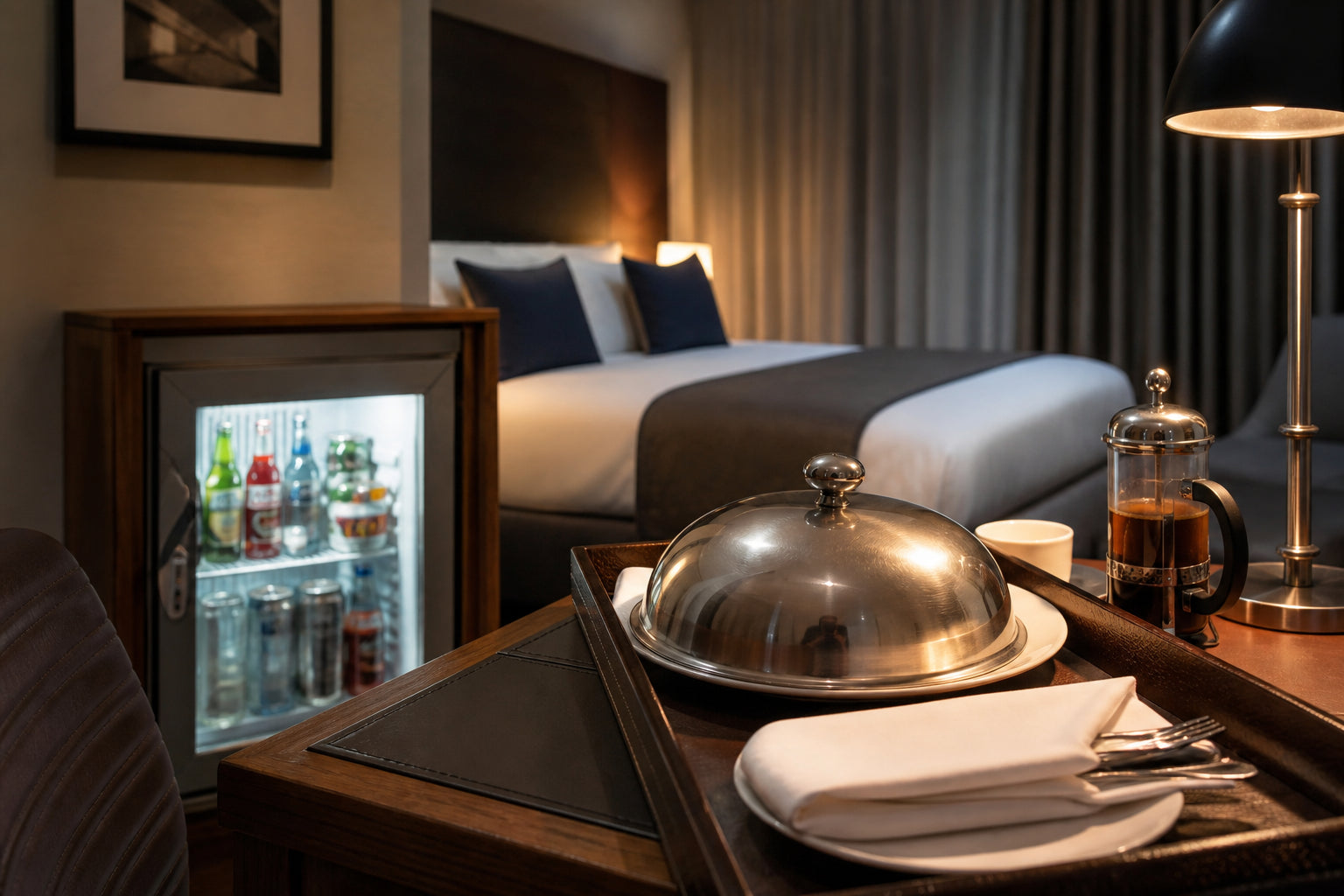
Because the experience is so personal, guests remember it vividly — in both directions. A tray delivered promptly, set down properly and collected without fuss becomes a story about being looked after. A cold burger, a missing fork or a tray sitting in the corridor overnight becomes a story too, and it is the kind that surfaces in reviews. This guide sets out the standards that decide which story gets told, and the in-room equipment that quietly supports all of them.
Why in-room dining punches above its weight
On the P&L, room service is often a modest line. In the guest's memory, it is anything but. Three things give it outsized weight.
First, it happens at emotionally loaded moments: the late arrival after a delayed train, the parent feeding a child before an early start, the couple marking an anniversary. Get the service right at those moments and the goodwill attaches to the whole stay.
Second, it is a promise with a timestamp. The guest is told a time, and then they wait, hungry, watching the clock. Few hotel services are so directly measurable by the guest. Beating a quoted time delights; missing it — even by a little — frustrates in a way a slow restaurant course never quite does.
Third, it exposes coordination. A successful tray requires the phone or app, the kitchen, the pass and the floor to work in sequence. Guests cannot see the machinery, but they feel the result, and they reasonably assume that a hotel which coordinates a club sandwich well probably coordinates everything else well too.
Ordering: make the promise clear
The experience starts long before the knock at the door, and most failures are seeded at the ordering stage.
- An honest, current menu. Whether printed, on the TV or reached by QR code, the menu must match what the kitchen can actually produce at that hour. An out-of-date menu forces the order-taker to apologise before the service has begun.
- Clear hours and realistic times. State when full service runs and what the overnight offer is, and quote delivery times the operation can beat. A quoted forty minutes that arrives in thirty feels generous; a quoted twenty that arrives in thirty-five feels broken.
- Capture the details that prevent second trips. Allergies, cooking preferences, condiments, extra cutlery for sharing — a good order-taker asks, because every omission becomes a phone call and a second journey upstairs.
- Confirm the essentials back. Room number, order, time. Ten seconds of repetition prevents the single most damaging failure: the tray that goes to the wrong door.
Delivery and presentation: the ninety seconds that count
The delivery itself is brief, but it is the part guests replay. The standard should be specific enough to train.
- Knock, announce, wait. A clear knock, "Room service", and a genuine pause. The guest is in their private space and may need a moment; hurrying this step sours everything that follows.
- Ask where to set up. Desk, table or bed tray — the guest chooses. Setting down, arranging the items and removing covers ceremonially takes seconds and transforms the perceived value of the same food.
- Check completeness before leaving. Cutlery, napkin, condiments, drinks, glasses. The most common in-room dining complaint is not the food; it is the missing item discovered after the server has gone.
- Explain the collection arrangement. Tell the guest what to do with the tray — call when finished, or place it outside — so the room is not left hosting the remains for hours by default.
- Temperature is the test. Hot food cooling in a corridor is the physics problem behind most food complaints. Cloches, insulated transport where distances are long, and routes planned to avoid detours all matter more than menu ambition.
The quiet infrastructure: what the room itself provides
Room service is not only the tray that comes upstairs. For much of the day — and all of the night at many properties — in-room dining is whatever the room itself can offer. That makes the in-room equipment part of the F&B standard, not just the furnishing list.
- The hospitality tray. A reliable kettle, clean cups and properly stocked tea and coffee are the most-used dining service in the hotel. A guest who can make a decent hot drink at 6 a.m. is far more forgiving of everything else.
- The minibar or guest fridge. A quiet, well-stocked minibar extends the offer around the clock, and an empty guest fridge lets visitors chill their own milk, medication or wine. Silence matters: a compressor cycling all night converts a dining amenity into a sleep complaint. Absorption or thermoelectric hospitality models avoid that trade-off.
- Surfaces and seating. If the property sells in-room dining, the room needs somewhere to dine: a clear desk or table and a chair that can be drawn up to it. A tray balanced on a bed because every surface is occupied undermines the whole proposition.
- Glassware and cutlery basics. Water glasses, wine glasses where the tier calls for them, and a bottle opener spare the guest the small indignity of drinking wine from a bathroom tumbler.
Standardising this equipment across the estate pays the same dividends here as elsewhere: identical trays and fridges are faster to restock, simpler to maintain and easier to audit. Hospitality-grade options for all of it can be found in the Roomwell products collection.
Tray collection: the standard most hotels forget
Nothing undoes a good in-room dining experience like its aftermath. A finished tray left in the room forces the guest to live with congealing plates; a tray left in the corridor greets every other guest on the floor with someone else's leftovers. Collection is not an afterthought — it is the closing scene of the service.
A workable collection standard has three parts:
- A defined trigger. The guest calls, or trays placed outside doors are collected on a stated schedule. Either works; silence about it does not.
- Regular corridor sweeps. Floors should be walked at set intervals during and after service hours, because many guests will put a tray outside regardless of instructions.
- Overnight ownership. Someone on the night team owns tray collection, so early-morning corridors are clear before the day's first impressions are formed.
An operator's in-room dining checklist
- Menu current, honest about hours, with realistic quoted times
- Order confirmation includes room number, items and time
- Hot food covered and transported to arrive hot
- Delivery: knock, announce, wait, set up where the guest chooses
- Completeness checked before the server leaves the room
- Collection arrangement explained at delivery
- Corridor sweeps scheduled; night team owns overnight collection
- Kettle, tray and consumables complete in every room
- Minibar or guest fridge cold, clean, quiet and stocked to spec
- A clear surface and seat available for dining in every room type
Service guests take personally
In-room dining is hospitality delivered to the most personal space a hotel offers, at the moments guests are least equipped to shrug off a failure. The standards that make it work are not exotic: honest promises, hot food, complete trays, respectful delivery and prompt collection — all supported by in-room equipment that carries the offer through the hours the kitchen is closed. Hotels that treat those basics as trainable, auditable standards turn a modest revenue line into one of the most remembered services in the building.
Quick answer: Room service arrives at the guest's most private space, often at their most tired moment — which is exactly why they remember how it was done. Here are the standards that make in-room dining a strength rather than a gamble.
Benefits
- Protects guest sleep with quieter cooling in the room.
- Supports higher review scores linked to rest and comfort.
- Gives operators a clear specification choice (absorption vs compressor).
- Improves perceived luxury when stock presentation is clean and chilled.
Features
- Quiet cooling technology suited to bedside or cabinet placement.
- Solid or glass door options for brand presentation standards.
- Capacities matched to room type rather than one estate-wide default.
- Hotel-grade build for continuous hospitality duty cycles.
Frequently asked questions
Why do silent minibars matter for hotel reviews?
Because noise at night is a common complaint. A quieter unit protects sleep and reduces negative comments about humming fridges.
Is absorption better than compressor for guest rooms?
For most UK guest rooms, absorption is preferred for near-silent operation. Compressor units suit warmer loads or non-sleep spaces.
What should operators check when installing a minibar?
Ventilation clearances, level fit, door finish, capacity by room type, and that the unit does not rattle against cabinetry.
Do guests expect a stocked minibar in every hotel?
Expectations rise with star level. Mid-scale rooms often use an empty fridge; luxury rooms more often stock a quiet chilled minibar.
Roomwell supplies the in-room equipment behind that standard — silent-running minibars, guest fridges, kettles and hospitality trays, and the accessories around them — to hotels across the UK. Browse the range in our Roomwell products collection, or contact our team to specify rooms that support in-room dining around the clock.