

Every luxury guest room has a square metre that works harder than any other: the refreshment corner. The minibar below, the hospitality tray and kettle above, glassware and accompaniments arranged between them. Guests visit it within minutes of arriving, return to it last thing at night, and start the next morning there before they have opened the curtains. No other part of the room is touched as often — and few parts of the room are specified with less thought.
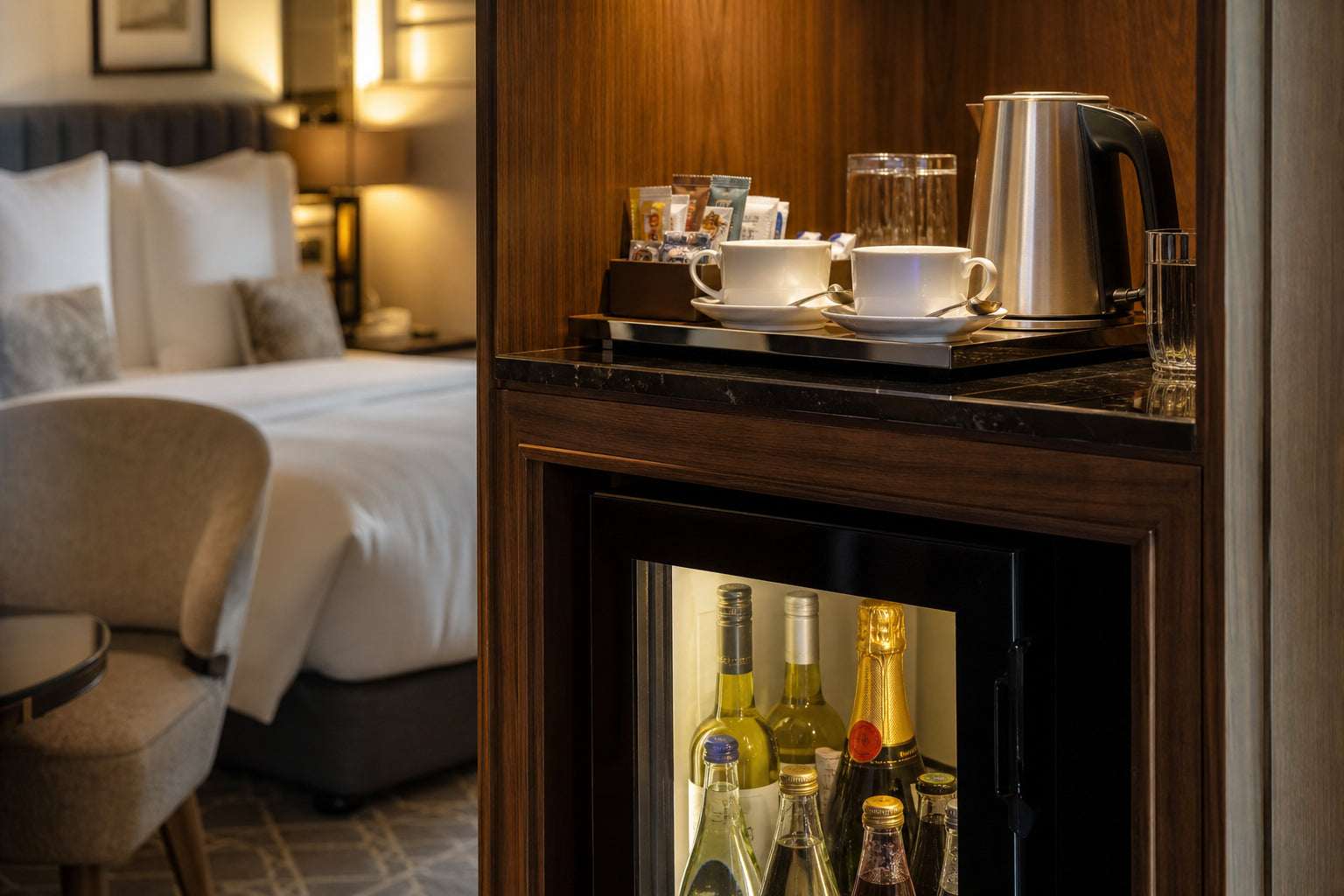
That is a missed opportunity, because the refreshment setup is where a property's standard becomes tangible several times a day. A silent, well-stocked minibar and a proper tea and coffee station quietly confirm the room's quality on every use; a humming fridge and a tired tray contradict everything the lobby promised. This guide covers how to specify both halves of the setup — the minibar and the hospitality tray — and how to present and run them to a luxury standard.
The minibar: specification before stocking
Operators tend to debate what goes in the minibar long before they consider the unit itself. That is backwards. The unit determines whether the guest's experience of everything inside it is positive, and four specification points do most of the work:
- Silent operation. In a luxury bedroom the minibar usually sits within a few metres of the pillow, and a compressor that cycles on at 3am is the single most common self-inflicted noise complaint in hospitality. Absorption minibars cool with no compressor and no moving parts in the cooling circuit — genuinely silent, which is why they are the default choice for bedrooms and suites.
- Stable cooling. The unit must hold a consistent, drinks-appropriate temperature through a warm summer night with the heating of a full load of restocked bottles. Guests forgive a limited selection; they do not forgive warm white wine.
- The right capacity and format. A generous suite setup and a compact double-room unit are different products. Glass-door models display the offer and invite use; solid doors suit properties that prefer discretion. Match the format to the room type rather than buying one model estate-wide by default.
- Fit and finish. The minibar lives inside joinery guests inspect at close range. Quiet door action, soft interior lighting and a snug, rattle-free installation are part of the specification, not afterthoughts.
Get these four right and the stocking strategy — whatever it is — lands well. Get them wrong and the finest curation in the world is sitting in a warm, noisy box.
Stocking philosophy: curation over clutter
Luxury minibar thinking has moved decisively from "as many lines as possible" to "the right lines, generously presented". A tightly curated offer looks intentional, is faster to check and restock, and wastes less. Principles that hold across most properties:
- Cover the core moments. Still and sparkling water, a quality soft-drink option, something for a nightcap and something for a celebration. Every addition beyond that should earn its shelf space.
- Reflect the property. Local or house-branded items give the minibar a point of view that a generic multinational line-up never will.
- Decide your commercial model deliberately. Charged minibars, complimentary soft offerings with charged alcohol, or fully complimentary setups in suites are all defensible — what damages trust is ambiguity. Price and label clearly, or include it clearly.
- Split chilled from ambient. The minibar holds what benefits from cooling; snacks and dry goods present better in a drawer or on open shelving beside it, where they also free up chilled capacity.
Whatever the model, the operational disciplines are the same: a documented stocking plan per room type, restocking checks on every turnover, and dates rotated so nothing in the unit is ever past its best. An empty slot is a missed sale; an expired item is a review.
The hospitality tray: the kettle is the anchor
In UK hotels the tea and coffee station is not an optional extra at any tier — it is close to a cultural obligation, and in luxury rooms it is a ritual guests perform daily. The tray succeeds or fails on its anchor appliance: the kettle.
A luxury-grade kettle earns its place with a fast, quiet boil, a clean pour, a secure base and an interior that stays presentable under a descaling schedule — UK water is frequently hard, and limescale is the fastest way for a premium tray to start tasting like a budget one. Around the kettle, the tray itself should be built to a written standard:
- Matched cups or mugs appropriate to the property's tier, with saucers where the brand standard calls for them.
- A genuinely good tea and coffee selection — a proper cafetière or premium bags rather than the thinnest sachets available — with clearly fresh milk provision.
- Teaspoons, a small waste solution for used items, and a tray surface that wipes clean and always looks composed.
- Identical presentation in every room, so housekeeping can restock by pattern and audits take seconds.
Where space allows, luxury properties increasingly stage the tray and minibar together as a single refreshment station — a run of joinery with the silent minibar below, the kettle and tray at working height, glassware and accompaniments arranged between. Presented this way, two modest pieces of equipment read as one generous amenity.
Presentation and daily operation
The refreshment setup is serviced more often than almost anything else in the room, so its standard is only as good as its turnover routine. The properties that do this well make the routine mechanical:
- One layout, photographed. A reference photo of the correct setup per room type ends drift. Housekeeping matches the picture; supervisors audit against it.
- Check function, not just stock. Kettle boils and sits square on its base; minibar is cold, silent and lit; glassware is polished. Thirty seconds per room protects the whole standard.
- Descale and deep-clean on a schedule. Kettles on a fixed descaling rota, minibar interiors wiped and door seals checked — before guests notice, not after.
- Standardise the estate. One kettle model, a small set of minibar formats. Spares, training and replacements all get simpler, and every room delivers the same experience.
None of this is glamorous, which is rather the point. The refreshment corner delivers its luxury through repetition: the same cold bottle, the same quick boil, the same composed tray, every single day of the stay.
A small station with a long reach
Judged by floor area, the refreshment setup is a footnote. Judged by guest contact, it is one of the most important amenities in the room — used more often than the bath, inspected more closely than the wardrobe, and remembered in the small hours when everything else is dark. Specifying it deliberately — a silent absorption minibar, a hotel-grade kettle, a tray built to a written standard — is one of the highest-return decisions available to a luxury operator, and one of the least expensive.
Quick answer: The refreshment corner is the most-used square metre in a luxury guest room. Here is how to specify the minibar, kettle and hospitality tray so it earns its keep on every stay.
Benefits
- Protects guest sleep with quieter cooling in the room.
- Supports higher review scores linked to rest and comfort.
- Gives operators a clear specification choice (absorption vs compressor).
- Improves perceived luxury when stock presentation is clean and chilled.
Features
- Quiet cooling technology suited to bedside or cabinet placement.
- Solid or glass door options for brand presentation standards.
- Capacities matched to room type rather than one estate-wide default.
- Hotel-grade build for continuous hospitality duty cycles.
Frequently asked questions
Why do silent minibars matter for hotel reviews?
Because noise at night is a common complaint. A quieter unit protects sleep and reduces negative comments about humming fridges.
Is absorption better than compressor for guest rooms?
For most UK guest rooms, absorption is preferred for near-silent operation. Compressor units suit warmer loads or non-sleep spaces.
What should operators check when installing a minibar?
Ventilation clearances, level fit, door finish, capacity by room type, and that the unit does not rattle against cabinetry.
Do guests expect a stocked minibar in every hotel?
Expectations rise with star level. Mid-scale rooms often use an empty fridge; luxury rooms more often stock a quiet chilled minibar.
Roomwell supplies silent absorption minibars, hotel kettles and complete hospitality-tray equipment to hotels across the UK, specified for heavy daily use and consistent presentation. Browse the Roomwell product range, or contact our team to build a refreshment standard for every room in your estate.