

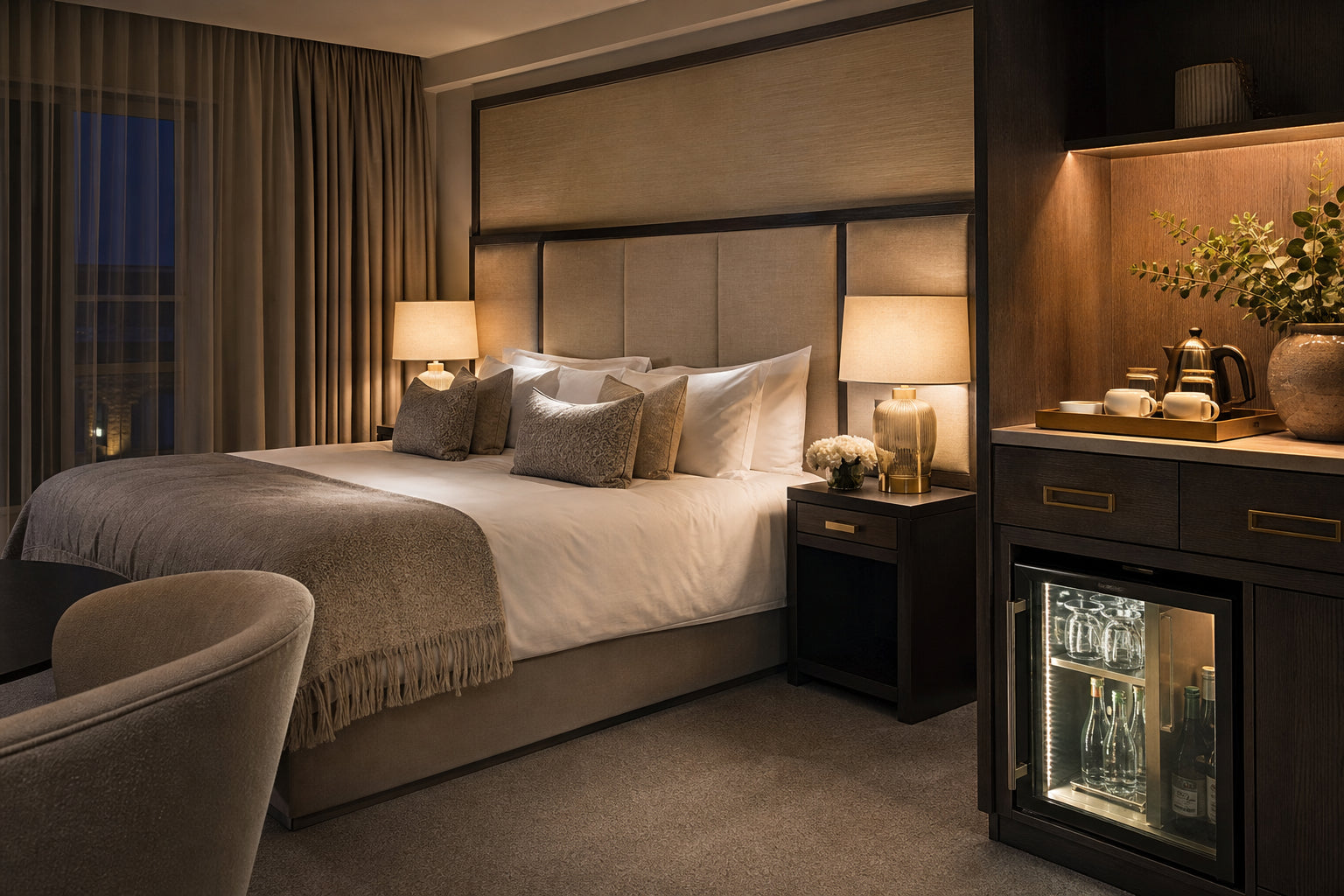
Guests rarely photograph a hotel room's floor plan. They photograph the bed with its layered cushions, the lamp glow against a textured wall, the composed corner where the coffee tray sits. What they are capturing — and what they are really paying for at the luxury end — is ambience: the sense that everything in the room belongs together and was arranged with them in mind. Ambience is why two rooms of identical size and specification can feel a category apart.
But ambience is often misunderstood as pure decoration — wallpaper, artwork, scatter cushions. In practice it is a system: lighting, materials, colour, sound, scent and detail working in concert, with nothing breaking the spell. And in that last clause lies the operator's real challenge, because the things most likely to break the spell are not decorative choices but functional ones — the humming appliance, the mismatched tray, the plastic kettle on a marble surface. This guide covers how luxury rooms build atmosphere, and how to make sure the working equipment of the room belongs to the picture rather than puncturing it.
Lighting: the single biggest lever
If a property can invest in only one aspect of ambience, it should be lighting. Nothing else changes how a room feels as quickly or as completely. The luxury approach is layering — several independent sources at different heights, each doing a different job:
- Ambient light from concealed or indirect sources rather than a single ceiling fitting, so the room never sits under flat, institutional brightness.
- Task light where guests actually do things: reading lights at the bed that one guest can use without waking the other, a desk lamp, proper illumination at the mirror.
- Accent light that gives the room depth after dark — a glow inside joinery, a picture light, the soft illumination of a glass-fronted minibar displaying its bottles like a small vitrine.
- Warmth and control. Warm colour temperatures throughout, dimming where the budget allows, and simple switching — a beautiful scheme guests cannot operate is a complaint, not an ambience.
The discipline extends to darkness. Blackout that genuinely blacks out, and standby LEDs specified or masked so the room can go fully dark, are as much a part of the lighting scheme as the lamps. Luxury is being able to choose both the glow and the black.
Materials, colour and texture
Luxury rooms feel expensive before the guest touches anything, and materials are why. The reliable principles:
- Natural and tactile beats shiny and printed. Wood, stone, linen, wool, leather and quality veneers age gracefully and reward touch; laminates and gloss finishes photograph adequately and disappoint in person.
- A restrained palette with layered texture. Most luxury schemes hold to a few calm colours and generate richness through texture — bouclé against smooth plaster, a wool throw on crisp cotton — rather than through pattern and contrast.
- Durability as a design criterion. Hospitality interiors take domestic wear at industrial pace. Fabrics, edges and finishes specified for contract use keep the room feeling composed in year three, which is when ambience budgets are usually won or lost.
- Coherent joinery. Built-in wardrobes, desks and refreshment units in one considered family of finishes pull a room together in a way freestanding furniture rarely does — and they give the room's equipment a home, which matters more than it sounds.
The senses beyond sight: sound and scent
Guests register a room's atmosphere with their ears and nose before they can articulate why. Two disciplines do the work:
Quiet. A luxurious room is a quiet room, and quiet is partly a décor outcome — carpets, curtains, upholstered surfaces absorbing sound — and partly an equipment decision. The classic ambience-killer is the minibar compressor cycling on in a silent bedroom at night: every soft surface in the scheme is undone by one humming appliance beside the bed. This is why luxury properties specify silent absorption minibars in sleeping spaces; the cooling works without a compressor, so the quietest room in the building stays that way after lights-out. The same scrutiny applies to anything else that runs unattended — fan-coils, extractors, and doors and drawers that should close softly rather than announce themselves.
Scent and air. Nothing undermines a beautiful room like staleness. Fresh air handling, scrupulous housekeeping and, where the brand uses it, a subtle signature scent give the room an olfactory first impression that matches the visual one. Restraint matters — a scheme guests notice as "fresh" succeeds; one they notice as "perfume" does not.
The equipment has to belong to the picture
Here is the specification insight that separates rooms that hold their atmosphere from rooms that almost do: guests do not experience "décor" and "equipment" as separate categories. The kettle sits in the same visual field as the marble it stands on; the minibar lives inside the joinery the designer laboured over. If the working objects look like afterthoughts, the whole composition reads as staged rather than genuine.
Practical rules for equipment that supports ambience instead of fighting it:
- Choose finishes that converse with the scheme. Brushed stainless or matt-finished kettles and trays alongside stone and wood; hair dryers and safes in finishes that disappear into their locations rather than clashing with them.
- Give everything a designed home. The minibar recessed into joinery with ventilation planned, the tray styled on a dedicated surface, the ironing board behind a door made for it. Equipment perched where it fits is clutter; equipment housed where it belongs is styling.
- Let the right pieces be seen. A glass-door minibar with soft interior lighting is a genuine décor asset after dark — a small illuminated display that invites use. Not everything should hide.
- Specify for silence and softness. Quiet operation, damped doors, no standby glare. The equipment's job after 11pm is to be invisible and inaudible.
- Maintain to the same standard as the décor. A scaled kettle or a scuffed tray on a beautiful surface reads exactly like a stain on the carpet. Descaling rotas and condition checks are ambience maintenance, whatever the budget line calls them.
An operator's ambience checklist
Ambience survives on discipline more than budget. A twice-yearly walk-through per room type, done as a guest would experience it:
- Enter at dusk with only the lamps on. Does the room compose itself, or does one source glare and another leave a dead corner?
- Sit on the bed for two minutes in silence. What do you hear — and will it still be running at 3am?
- Make the room fully dark. Log every LED and light leak, then fix them.
- Look at every working object in the room — kettle, tray, minibar, hair dryer, bin. Does each one look chosen for this room, and is it in a condition the décor deserves?
- Open and close every door and drawer. Softly?
- Smell the room on entry, honestly. Fresh, neutral, or tired?
Each item is small; together they are the difference between a room that photographs well and a room that feels as good as it looks at midnight on the third night.
Atmosphere is specified, not sprinkled
Luxury ambience is not applied at the end of a project like a finish coat — it is the cumulative result of decisions made all the way down the specification: the lamp's colour temperature, the fabric's texture, the drawer's closing action, the minibar's silence. Properties that hold their atmosphere are simply the ones that made those decisions deliberately and maintained them stubbornly.
Quick answer: Ambience is not decoration — it is the sum of light, texture, sound and detail working together. Here is how luxury guest rooms create atmosphere, and why the equipment has to belong to the picture.
Benefits
- Thoughtful amenities convert arrival into a personal welcome.
- Tiered amenities control cost while protecting VIP impact.
- In-room essentials reduce requests and friction.
- Consistent presentation supports brand photography and reviews.
Features
- Core kit: tray, dryer, safe, towels and toiletries.
- Optional VIP layers: welcome notes, local produce, upgraded consumables.
- Room-readiness checks before amenity placement.
- Allergy-aware and preference-aware delivery rules.
Frequently asked questions
What is a welcome amenity really for?
To show the guest they were expected — personalisation and timing matter more than cost.
Should every VIP get the same amenity?
No. Tier by occasion, loyalty and value so generosity stays sustainable.
What room conditions must be ready before amenities?
Clean bathroom, made bed, working appliances, chilled/clean fridge or minibar, and correct temperature/lighting.
Which amenities are now considered baseline?
Wi-Fi, kettle tray, hair dryer, towels and a clean bathroom kit in most UK hotels.
Roomwell supplies guest-room equipment designed to belong in considered interiors — silent absorption minibars with glass-door options, elegant kettles and hospitality trays, discreet safes, hair dryers and bins — to hotels across the UK. Browse the Roomwell product range, or contact our team to specify equipment your décor can live with.