

Guests rarely compliment a clean room. They expect it. What they do notice — and write about — is inconsistency: the room that was immaculate on Tuesday and tired on Thursday, the kettle tray that was fully stocked at check-in and half-empty after the first service, the bathroom that smells fresh while the bin under the desk still holds yesterday's receipt. Housekeeping is judged not on its best room but on its most variable one.
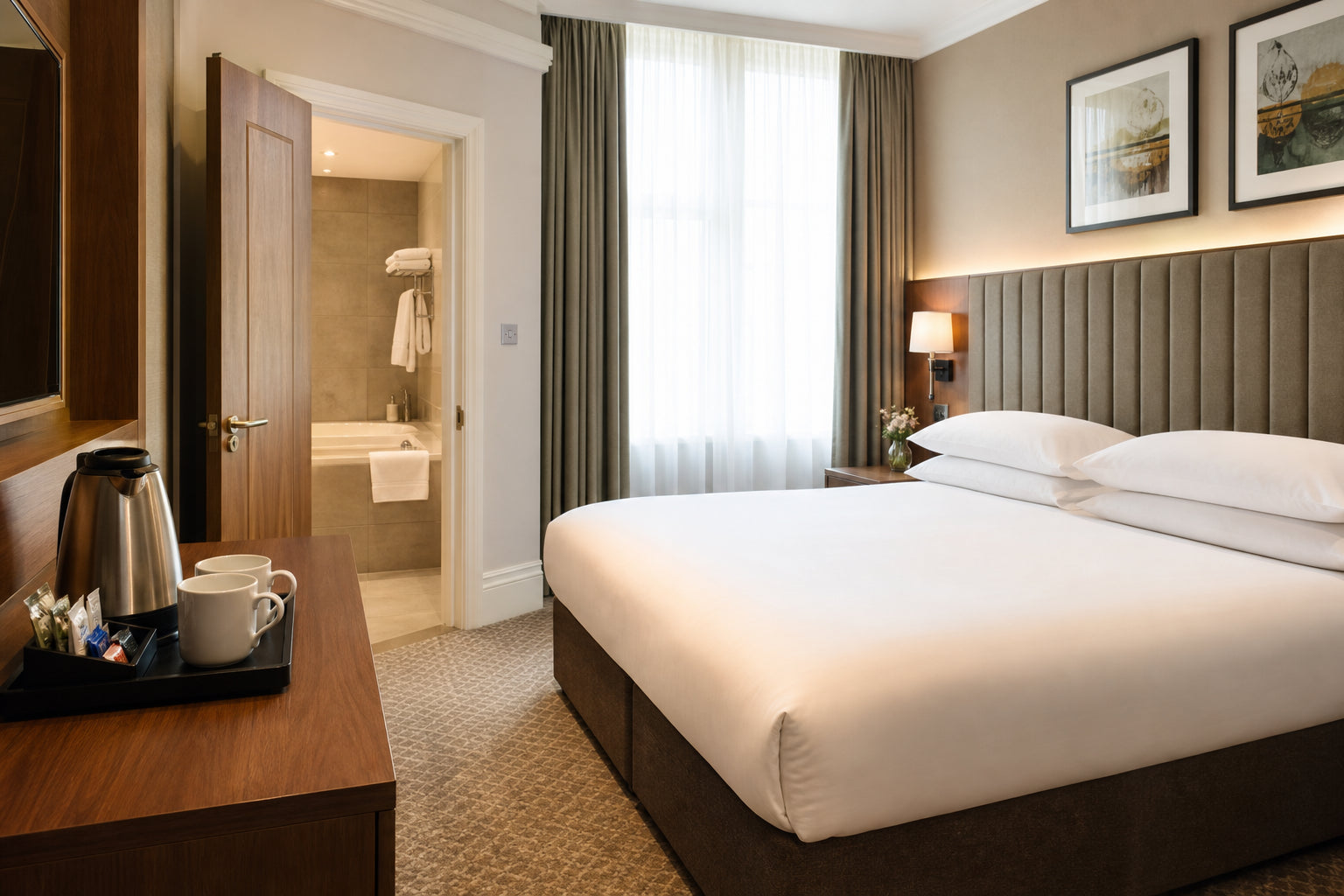
That is why the strongest housekeeping operations are built around standards rather than effort. Effort varies with staffing, occupancy and the individual on shift; a standard, properly defined and inspected, does not. This guide sets out how UK operators can define "room ready", sequence the clean, keep amenities and appliances to spec, and inspect in a way that catches drift before a guest does.
Define "room ready" — in writing, not in heads
Most inconsistency starts with a definition problem. If "room ready" lives in the heads of experienced room attendants rather than in a written specification, every departure and every new starter erodes the standard. Two people can both believe a room is finished and mean quite different things by it.
A workable room-ready definition is specific enough to be checked by someone who did not clean the room. It should cover, at minimum:
- Bed presentation — linen condition, pillow count and arrangement, how the bed is dressed and finished.
- Surfaces and floors — which surfaces are wiped on every service versus deep-cleaned on a cycle, and what "dust-free" means in practice (tops of headboards, skirting, lamp shades).
- Bathroom finish — sanitised fittings, dry and streak-free glass and chrome, towel fold and placement, replenished toiletries.
- Amenity set-up — exactly what sits on the hospitality tray, in the wardrobe and in the minibar, and how it is arranged.
- Appliance condition — kettle, hair dryer, safe, iron and ironing board, minibar: clean, working and presented the same way in every room.
- Final checks — lighting, TV and remote, heating set-point, curtains, bin liners, and anything left behind by the previous guest.
Write it per room type, photograph the finished standard, and put the photos where attendants can see them. A picture of the correct tray set-up settles more disputes than a paragraph of text ever will.
Sequence the clean so nothing depends on memory
A consistent room comes from a consistent order of work. When every attendant cleans in the same sequence, steps stop getting skipped under time pressure, and supervisors can spot where a shortfall crept in. A typical departure-clean sequence runs:
- Ventilate and strip. Open windows where possible, strip linen, remove rubbish and used amenities — everything out before anything new comes in.
- Apply bathroom chemicals early. Sanitiser needs contact time; starting the bathroom first and returning to it makes the dwell time productive rather than dead time.
- Make the bed. Fresh linen goes on before dusting so any lint settles before surfaces are wiped.
- Clean high to low, far to near. Dust falls downwards; working towards the door means no one walks back over finished floor.
- Finish the bathroom. Scrub, rinse, dry and polish — a wet bathroom is not a finished bathroom.
- Replenish and reset. Tray, toiletries, minibar, wardrobe amenities, then the final walk-round against the room-ready definition.
Stay-over services follow a shortened version of the same order. The point is not which exact sequence you choose but that there is one, it is trained, and it is the same in room 104 as in room 312.
Bathroom and bedroom: different jobs, different priorities
Guests forgive different things in different parts of the room, and the standard should reflect that. In the bathroom, the priority is hygiene and the appearance of hygiene: sanitised touchpoints, no hair anywhere, dry surfaces, and chrome and glass free of water marks. A bathroom can be genuinely clean and still read as dirty if the mirror is smeared or the plughole holds a single stray hair — perception is the standard here.
In the bedroom, the priority is order and freshness: a taut, well-dressed bed, clear and dust-free surfaces, no trace of the previous occupant, and amenities set out exactly to spec. Guests inspect the bathroom for cleanliness and the bedroom for care; a strong operation budgets its minutes accordingly rather than spreading time evenly across the room.
Replenishment: where standards quietly slip
Amenity replenishment is where good housekeeping most often goes unnoticed — and where weak housekeeping is most often caught. A guest may not register a spotless skirting board, but they will absolutely register two teabags where there were four, or a minibar missing the item they wanted on night two.
Build replenishment into the standard as a count, not a judgement call:
- The kettle tray — a defined number of teas, coffees, sugars and milks per occupancy, clean matched cups, teaspoons, and the tray itself wiped and squarely arranged. "Top up if it looks low" is not a standard; "reset to the photo" is.
- Toiletries — replace or top up to the defined set; part-used items handled according to a clear rule (typically replaced at departure, straightened at stay-over).
- Minibar checks — restock against the standard listing, check date codes on rotation, record consumption, and confirm the unit is cool, closed and quiet.
- Linen and towels — counts per room type, with a stated rule for stay-over reuse schemes so guests get what the card on the rail promises.
Replenishment standards also protect revenue and stock control: when every trolley is loaded against the same par list, shortages surface in the storeroom rather than in a guest review.
Appliances: wipe-down every service, deeper care on a cadence
In-room appliances sit in an awkward gap between housekeeping and maintenance, and that gap is where they deteriorate. The fix is to split their care into two explicit layers.
Every service: the kettle is emptied, wiped inside and out, and reseated on its base; the hair dryer is wiped, its filter glanced at and the cable coiled; the safe is checked open and empty at departure; the iron plate is checked for marks and the board cover for burns; the minibar door seal and interior are wiped where needed. This takes a disciplined attendant a couple of minutes and keeps appliances presentable between deep cleans.
On a cadence: kettles are descaled on a scheduled rotation — in most of the UK's hard-water areas, waiting for a guest to complain about flakes in their tea means waiting far too long. Hair dryer filters are cleaned, minibar condensers dusted and temperatures verified, and irons descaled or replaced on the same planned cycle. Log the cadence by room, not by memory; a simple rota per floor is enough. Specifying robust, consistent appliances across the estate makes both layers easier — one descaling routine, one spare-parts list, one standard to inspect. Our Roomwell guest-room range is chosen with exactly this kind of repeatable, estate-wide care in mind.
Inspect at more than one level
Standards decay without inspection, but inspection only works when it happens at several levels with different purposes:
- Self-check by the attendant — the final walk-round against the room-ready definition before the door closes. This catches the majority of misses at zero extra cost.
- Supervisor checks — a defined proportion of rooms checked daily against a written checklist, covering every attendant over the week, with findings fed back the same day. New starters and recently flagged rooms get checked at a higher rate.
- Management deep audits — periodic full-room audits that look beyond the daily clean: mattress turning, curtain condition, appliance age and performance, grout and sealant, the things a daily service never touches.
Score inspections simply and track them over time. The purpose is not to catch people out but to see drift early — a floor whose scores are sliding is telling you about training, staffing or equipment before the reviews do.
Training and SOPs: make the standard survivable
A standard that depends on your best long-serving attendants is a standard on borrowed time. Housekeeping has genuine turnover, and the operations that stay consistent are the ones where the standard survives any individual leaving. That means:
- Written SOPs per task, short and visual, kept where the work happens — on the trolley, not in a folder in the office.
- Structured induction with buddy shifts, and sign-off against the room-ready standard before anyone cleans unsupervised.
- Refresher sessions when inspection scores dip or when the spec changes — a new tray layout or amenity range should never be announced by rumour.
- Realistic time allocations per room type. A standard no one can meet in the minutes allowed is a standard you have quietly cancelled.
What inconsistency costs in reviews
Read guest reviews closely and a pattern emerges: the harshest cleanliness comments are rarely about a hotel that is uniformly poor. They are about broken expectations — "the first room was spotless, but when we came back after housekeeping…", "great stay last year, this time the bathroom let it down." Inconsistency reads as carelessness, and carelessness is the one thing guests reliably punish, because it makes them wonder what else varies: the linen, the food hygiene, the security.
Consistency works the other way too. A property that delivers the same well-presented room on every visit builds the kind of quiet trust that turns first-time guests into repeat bookers, even when the property itself is modest. Guests do not need luxury from housekeeping; they need to know exactly what they will walk into.
Quick answer: A guest cannot see your housekeeping SOP, but they can feel it. Here is how to define "room ready", build a repeatable cleaning sequence, and keep amenities and appliances to a standard guests notice — in every room, every day.
Benefits
- Consistent cleaning standards protect brand reputation.
- Clear checklists reduce missed amenities and rework.
- Faster room turns improve occupancy flexibility.
- Inspection discipline catches appliance and safety issues early.
Features
- Room-ready checklists covering bathroom, bed, tray and appliances.
- Standards for VIP vs standard resets.
- Maintenance escalation paths for broken kit.
- Training cues that keep every room on-brand.
Frequently asked questions
What should a guest-room inspection always include?
Bathroom spotlessness, bed presentation, hospitality tray, working appliances, safe reset and overall odour/noise readiness.
How do hotels keep standards consistent across staff?
Written checklists, sample rooms, and random inspections — not memory alone.
Why do missing amenities keep recurring?
Usually reset discipline, not purchasing. Standard kits and clear wardrobe layouts help.
Should VIP rooms use a different checklist?
Yes — same foundations plus welcome readiness, preferences and higher presentation detail.
Roomwell supplies kettles, minibars, hair dryers, safes, ironing equipment and guest-room accessories to hotels across the UK — specified for the repeated daily use and simple, consistent care that housekeeping standards depend on. Browse the range in our Roomwell products collection, or contact our team to standardise the appliances and amenities behind your room-ready spec.