

Guests imagine that luxury rooms stay luxurious on their own — that marble simply gleams and linen simply stays crisp. Operators know the truth: a luxury room is a perishable product, rebuilt from scratch every single day. Left alone, it degrades in weeks. What preserves it is the least celebrated partnership in the hotel: housekeeping and maintenance, working to standards most guests will never consciously notice.
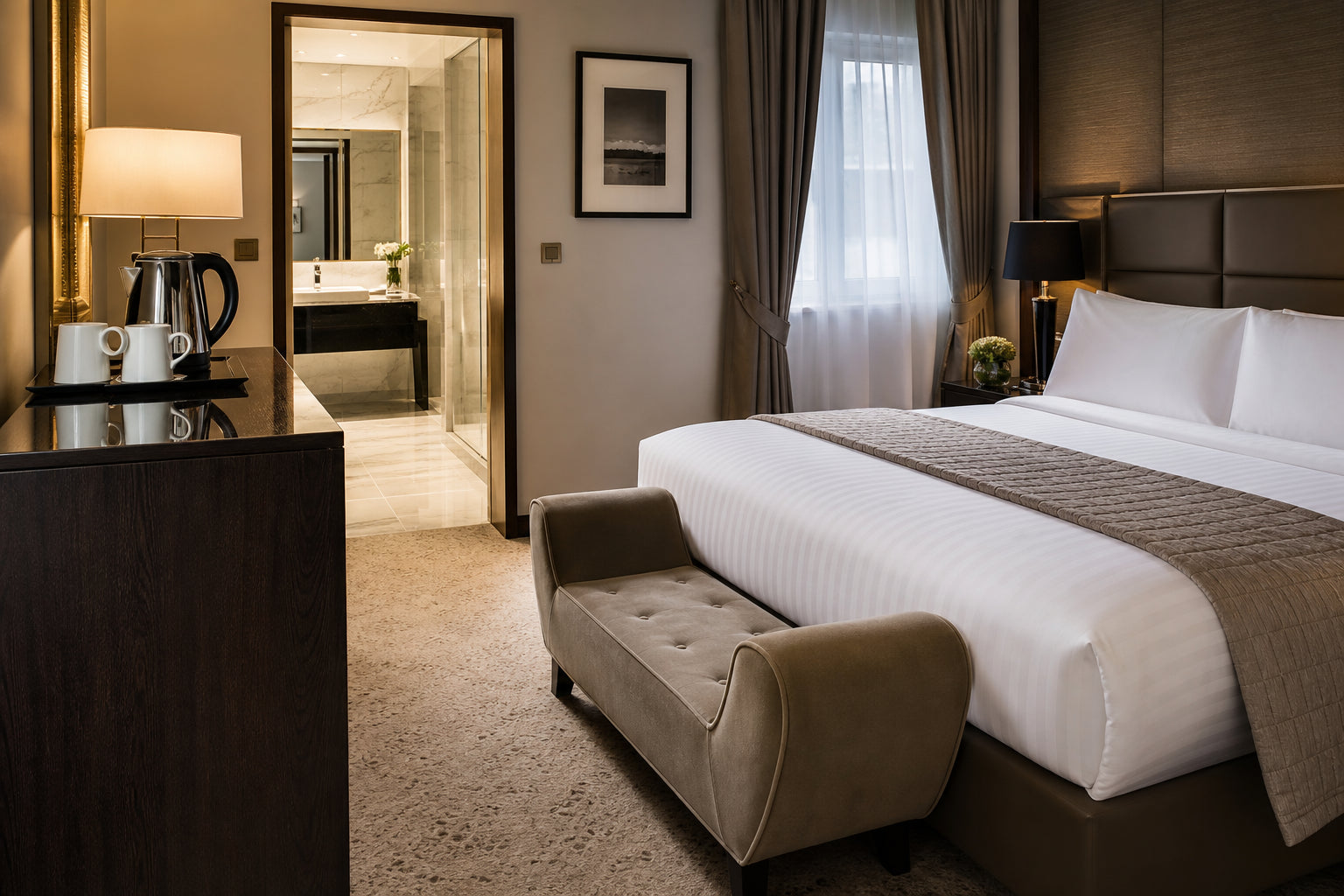
This article looks at how that partnership functions in top-tier rooms — the routines, the division of labour, the equipment care and the inspection culture — and at what operators in every segment can adapt from it.
Why luxury raises the housekeeping stakes
Housekeeping in a luxury room is not ordinary cleaning done more slowly. The product itself changes the nature of the work in three ways.
First, the tolerance for defects collapses. At a mid-market rate, a small scuff is invisible; at a luxury rate, the guest has effectively paid for its absence. The standard is not "clean" but "flawless-looking," which is a different inspection discipline entirely.
Second, the materials demand expertise. Natural stone, real wood, delicate fabrics, specialist finishes — luxury rooms are full of surfaces that generic products and rushed techniques actively damage. Housekeepers in these properties are trained on materials, not just on sequence: which cloth for the marble, which product never touches the brass, how the upholstery is treated.
Third, presentation becomes part of the product. The precise dressing of the bed, the alignment of amenities, the exact fold of the towels — in a luxury room, presentation is not garnish on the cleaning; it is a specified, photographed standard reproduced identically at every service.
The service rhythm: more touches, lighter footprints
Luxury housekeeping also runs to a different rhythm. Where a mid-market room is serviced once a day, a top-tier room typically receives a full morning service and an evening turndown, with refresh visits on request. More visits, however, come with a stricter rule: the guest should never feel the operation. Services are timed around the guest's patterns, entered rooms are left exactly as the guest arranged their belongings, and the work itself is quiet — no clattering trolleys outside occupied rooms, no vacuuming against the sleep hours of the corridor.
The operational implication is that luxury housekeeping is scheduled like a service, not a production line: fewer rooms per attendant, flexible sequencing driven by guest movements, and communication with the front office about who is in, out, or resting.
Maintenance: the silent partner
If housekeeping rebuilds the room daily, maintenance ensures there is something worth rebuilding. In luxury properties, the maintenance function shifts decisively from reactive to preventive — because at this tier, a guest-reported fault is not a work order, it is a failure of the entire promise.
The preventive architecture typically includes:
- A rolling room cycle — each room comes out of service on schedule for deep inspection: joinery, sealant, lighting, plumbing, every appliance operated and tested.
- Appliance care as routine — kettles descaled to a hard-water schedule, minibar temperatures and door seals checked, safe batteries and mechanisms tested, hair dryer filters cleared, iron soleplates inspected. Small tasks, but each one pre-empts the most common guest-facing failures.
- Fast cosmetic response — a touch-up culture in which chips, scuffs and marks are corrected in hours, because cosmetic decay is cumulative and quickly reads as tiredness.
- Replace-before-failure thresholds — equipment that shows wear is swapped, not nursed. A standardised appliance estate makes this a five-minute exchange rather than a procurement event.
That last point deserves emphasis. Luxury operators standardise their in-room equipment precisely so that maintenance can hold the standard: identical kettles, minibars, safes and dryers across the estate mean spares on the shelf, one testing routine, and a room never released with a mismatched or missing item. Operators building that kind of estate can specify from the Roomwell products collection, which is assembled for exactly this hold-the-standard role.
The handshake between the two departments
The defining feature of well-run luxury rooms is not either department's excellence in isolation — it is the quality of the handshake between them. Housekeeping sees every room every day; maintenance has the skills to act on what housekeeping sees. Properties that connect the two turn the housekeeping team into a full-coverage early-warning system.
The mechanics are simple and transferable to any property:
- Room attendants log faults the moment they see them — a sticking drawer, a flickering lamp, a kettle slower than its neighbours — through whatever channel the property uses, from an app to a paper sheet.
- Maintenance triages daily, fixing guest-facing items before the room is next sold.
- Closed faults are reported back, so housekeeping sees that reporting works — the single biggest factor in whether reporting continues.
- Recurring faults are reviewed monthly, because a lamp that fails three times is a specification problem wearing a repair costume.
Inspection: how the standard survives
Luxury properties formalise what other hotels leave to chance: the checking. Supervisors inspect serviced rooms against a written, illustrated standard — often room-type-specific — covering cleanliness, presentation, function and scent. Arrival rooms receive a final check that includes operating the guest-facing equipment: lights on, kettle boiled, safe cycled, television responding.
Two cultural details make this inspection regime work rather than rankle. The standard is objective — the room matches the photograph and the checklist, or it does not — which keeps inspection impersonal. And findings feed training rather than blame: patterns in inspection failures are treated as information about timing, materials or gaps in induction, not as individual shortcomings.
What every operator can borrow
Few properties have luxury budgets, but the disciplines above are mostly budget-neutral:
- Write and photograph the presentation standard — the single cheapest luxury practice, and the foundation of every other.
- Train on materials, even modest ones — the wrong product ages any surface prematurely.
- Schedule appliance care — descaling and function checks cost minutes and pre-empt the most common complaints.
- Connect housekeeping to maintenance with a reporting loop that visibly works.
- Standardise equipment so replacement is routine and rooms never diverge.
Luxury rooms stay luxurious because someone keeps them so, daily and deliberately. The keeping is a system — and systems travel across price points far more easily than marble does.
Quick answer: A luxury room is only luxurious on the day a guest walks in. Behind that daily miracle sit housekeeping and maintenance disciplines that most guests never see — and every operator can learn from.
Benefits
- Consistent cleaning standards protect brand reputation.
- Clear checklists reduce missed amenities and rework.
- Faster room turns improve occupancy flexibility.
- Inspection discipline catches appliance and safety issues early.
Features
- Room-ready checklists covering bathroom, bed, tray and appliances.
- Standards for VIP vs standard resets.
- Maintenance escalation paths for broken kit.
- Training cues that keep every room on-brand.
Frequently asked questions
What should a guest-room inspection always include?
Bathroom spotlessness, bed presentation, hospitality tray, working appliances, safe reset and overall odour/noise readiness.
How do hotels keep standards consistent across staff?
Written checklists, sample rooms, and random inspections — not memory alone.
Why do missing amenities keep recurring?
Usually reset discipline, not purchasing. Standard kits and clear wardrobe layouts help.
Should VIP rooms use a different checklist?
Yes — same foundations plus welcome readiness, preferences and higher presentation detail.
Roomwell supplies UK hotels with the standardised, hospitality-grade equipment that keeping a standard depends on: kettles, silent minibars, hair dryers, safes, ironing equipment and room accessories. Browse the Roomwell range, or contact our team to build an equipment estate your housekeeping and maintenance teams can hold.