

Ask seasoned hoteliers where guests form their sharpest judgements about quality and many will give the same answer: the bathroom. Guests forgive a dated corridor and barely register the lobby art, but the bathroom is examined at close range, barefoot, several times a day. It is where cleanliness, investment and attention to detail are impossible to fake — and where a luxury property either confirms its rate or quietly contradicts it.
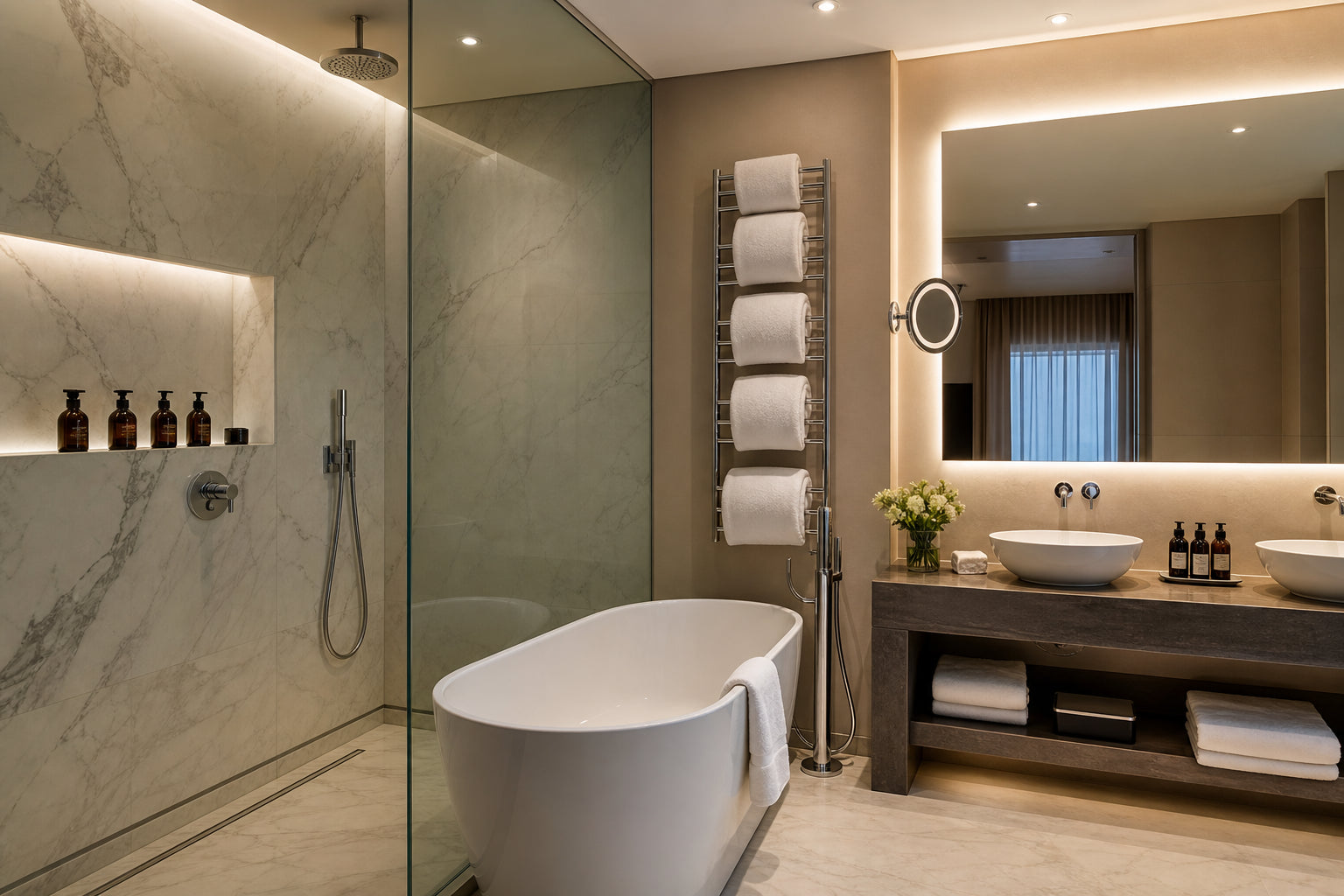
That scrutiny makes the bathroom one of the highest-return areas of a guest room to specify well. This guide works through the elements of a genuinely high-end hotel bathroom — fittings, towels and textiles, toiletries, and the grooming equipment around them — with the operational disciplines that keep the standard consistent across an estate.
Fittings: where the money should go first
The permanent fittings define the bathroom's ceiling of quality — nothing placed on the shelf afterwards can raise it. The elements that matter most to guests, roughly in order of how often they are mentioned in feedback, are:
- The shower. A walk-in shower with strong, stable water pressure, a generous rain head plus a handheld attachment, and controls a stranger can operate at first attempt. Thermostatic mixing keeps the temperature steady when water is drawn elsewhere in the building — a detail guests feel immediately even if they never name it.
- The bath, where space allows. At the top end a freestanding or well-proportioned built-in bath signals indulgence, but a cramped bath is worse than none; many luxury properties now prioritise an exceptional shower over a token tub.
- The vanity. Generous counter space for two people's washbags, a large well-lit mirror, and a separate illuminated magnifying mirror for grooming. Storage that keeps the guest's own items ordered keeps the whole room feeling calm.
- Warmth. Underfloor heating and a heated towel rail turn a functional room into a comfortable one, and dry towels between uses — a hygiene benefit as much as a luxury.
- Lighting. Layered and flattering: bright, shadow-free task light at the mirror, softer ambient light for the bath, and a discreet night level so a 3am visit does not mean full brightness.
- Ventilation that works silently. A bathroom that clears steam quickly without roaring protects mirrors, finishes and the guest's patience alike.
Towels, robes and textiles: quality by the handful
Bathroom textiles are the linens' equivalent in the wet zone: guests assess them by touch within seconds. The specification points that separate luxury from adequate are weight and density of the cotton, size — bath sheets rather than mean bath towels — absolute whiteness, and abundance. A five-star bathroom is never one towel short, and replacement is instant the moment an item shows greying, thinning or pulled loops.
Robes and slippers extend the spa feeling into the bedroom and are among the most-remembered comfort touches in guest feedback. As with bed linens, the operational backbone is unglamorous: sufficient par levels, commercial laundering standards agreed and audited, and housekeepers empowered to condemn substandard items on sight rather than stretching them one more cycle.
Toiletries: the small bottles that carry the brand
Toiletries are the bathroom's most portable impression — often the only part of the room a guest physically takes home in memory, and sometimes in their washbag. Getting them right involves three decisions:
- Quality and scent. Formulations that feel genuinely good to use, with a scent profile that suits the property. Many luxury hotels partner with recognised or local artisan brands precisely because the label on the bottle transfers credibility to the bathroom shelf.
- Format. The industry has moved decisively towards full-size refillable dispensers, driven by waste-reduction commitments and, in many territories, regulation of single-use miniatures. Done well — locked, tamper-evident, elegant vessels, refilled and sanitised to a written procedure — dispensers now read as premium rather than economical. Done carelessly, a half-empty, unlabelled pump bottle reads as a shortcut; the procedure matters more than the format.
- Completeness. Beyond shampoo, conditioner, body wash and lotion: quality soap at every basin, and a drawer of anticipated needs — dental kits, shaving kits, cotton pads and buds, sewing kit, shower cap, sanitary items — available in the room or instantly on request.
Grooming equipment: the appliances guests actually use
Around the fittings and toiletries sits a small set of appliances that guests handle directly, and judge accordingly:
- The hair dryer is the headline item. Guests — particularly frequent travellers — notice immediately whether they have been given a professional-standard dryer or a token wall unit with a warm sigh. A powerful, well-balanced dryer, stored in a dedicated bag or drawer rather than tangled behind the door, is one of the least expensive upgrades with a direct line to review scores.
- Illuminated magnifying mirrors, mounted at a usable height with flattering colour-accurate light, serve every guest who does close grooming work.
- Scales, straighteners on request, and shaver points at sensible locations round out the offer at the top tier.
- Bins and consumables logistics — a lidded, easily sanitised bin, discreetly placed and emptied to standard — keep the room's order intact through the stay.
The same estate logic applies here as everywhere in the guest room: one specified model per item, identical across every bathroom, so spares, training and guest expectations never depend on room allocation. Operators can standardise this layer from our Roomwell guest-room range, which includes professional hair dryers and bathroom-adjacent guest-room equipment specified for hotel use.
Consistency and condition: the operational standard
A luxury bathroom is a maintenance commitment as much as a design achievement. Water, heat and heavy daily use attack grout, seals, chrome and stone relentlessly, and guests read the results at close range. The disciplines that protect the investment are:
- A written bathroom standard — every item, its position, its condition threshold — so housekeeping sets and audits identically across the estate.
- Preventive maintenance cycles for sealant, grout, water pressure, drainage speed and ventilation, caught on schedule rather than by complaint.
- Deep-clean rotations beyond the daily service, keeping glass, stone and metalwork at open-day standard.
- Experience audits — running the shower to temperature, drying hands on the actual towels, using the hair dryer — because guests test the bathroom, not read about it.
It is worth remembering how UK quality schemes such as the VisitEngland and AA star ratings encounter a property: through an ordinary stay, in whichever room the assessor happens to receive. The bathroom in that room is the bathroom that represents the estate — which is the strongest argument for every bathroom being indistinguishable from the best one.
The bathroom as a rate justification
Few areas of a hotel repay investment as directly. An exceptional bathroom features in photographs, drives review mentions, and gives guests a tangible answer to the question every luxury rate implicitly asks: what am I paying for? Specify the fittings for performance, the textiles for touch, the toiletries for memory and the appliances for daily use — then run the operational disciplines that keep all of it identical, every room, every day.
Quick answer: Guests judge a hotel's true standard in the bathroom. Here is how five-star properties specify fittings, towels, toiletries and grooming equipment — and keep every bathroom identical to the best one.
Benefits
- Improves readiness for dinners, meetings and leisure plans.
- Reduces amenity requests and front-desk friction.
- Supports a premium feel even in compact rooms.
- Cuts replacement cost when hotel-grade units are standardised.
Features
- Higher wattage suited to hospitality expectations.
- Wall-mounted or handheld formats by brand standard.
- Secure mounting and cable management for safety.
- Consistent models across room types for easier maintenance.
Frequently asked questions
What wattage should hotel hair dryers use?
Guests increasingly expect strong performance; underpowered units are a frequent complaint. Specify hotel-grade power for your brand tier.
Wall-mounted or handheld — which is better?
Wall-mounted units reduce theft and clutter; handheld units can feel more premium. Choose by brand standard and loss risk.
Where should the dryer be placed?
Near a mirror with safe cable routing, away from water splash zones, and easy for housekeeping to reset.
Do hair dryers affect reviews?
Yes — missing or weak dryers are common negative mentions, especially for leisure guests.
Roomwell supplies UK hotels with the guest-room equipment that completes the standard — professional hair dryers, minibars, safes, kettles and more, specified for reliable estate-wide performance. Browse the full range in our Roomwell products collection, or contact our team to specify equipment for your next bathroom and bedroom refurbishment.