

Ask a guest what makes a good hotel and they will talk about the bed, the shower, the quiet, the little conveniences that simply worked. Ask an operator, and they will describe something else entirely: the daily machinery that produces that experience in every room, every day, regardless of who checked out an hour earlier. That machinery is guest room operations — the least glamorous and most important discipline in the hotel.
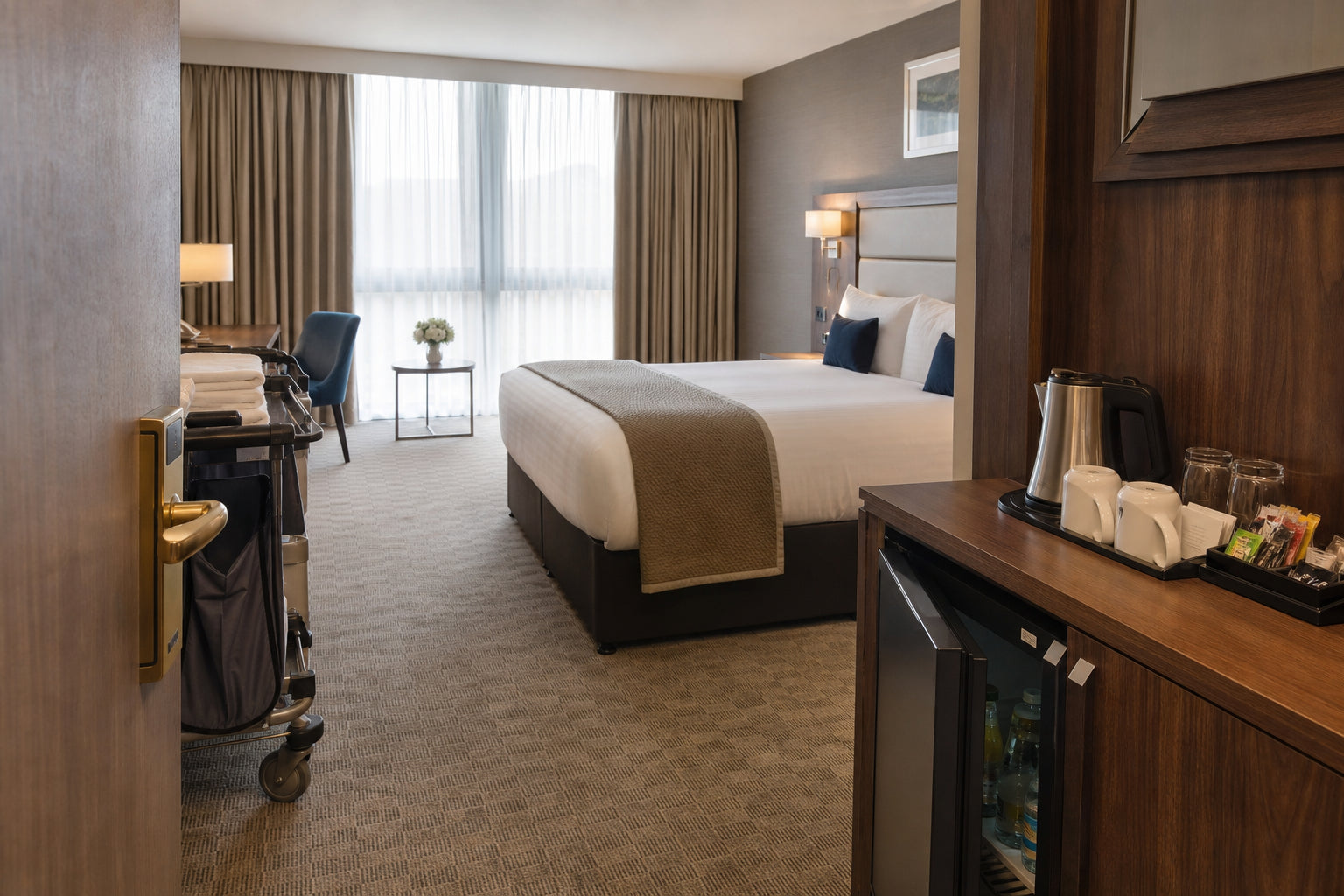
This overview is written for operators, room-division managers and anyone taking on responsibility for guest rooms for the first time. It maps the main components of room operations, shows how they connect, and highlights the points where consistency is usually won or lost.
What guest room operations actually cover
"Room operations" is shorthand for everything required to take a room from one guest's departure to the next guest's arrival, and to keep it serviceable in between. In practice it spans five interlocking areas:
- Turnover and housekeeping — stripping, cleaning, remaking and presenting the room to a defined standard within a defined time.
- Maintenance — keeping the fabric of the room and its equipment (heating, lighting, appliances, plumbing) in working order, both reactively and preventively.
- Amenities and consumables — stocking, replenishing and presenting everything the guest touches: the hospitality tray, toiletries, linen, minibar contents, stationery.
- Equipment and appliances — the working items that live in the room permanently: kettles, hair dryers, safes, minibars, irons and ironing boards, TVs.
- Coordination with the front office — the flow of information about arrivals, departures, early check-ins, late check-outs, room moves and guest requests.
None of these areas is difficult in isolation. The challenge — and the craft — is running all five at once, across dozens or hundreds of rooms, with a team that changes shift by shift, to a standard the guest experiences as effortless.
The turnover cycle: the heartbeat of the operation
Every room in the hotel is, at any moment, in one of a small number of states: occupied, due out, vacant dirty, vacant clean, out of order. The job of room operations is to move rooms through those states predictably. The turnover cycle — departure, strip, clean, check, release — is the heartbeat, and the operation is only as healthy as its weakest step.
A well-run turnover follows a repeatable sequence:
- Strip and reset. Linen and towels out, rubbish cleared, tray and minibar checked, lost property logged.
- Clean to a sequence. Most operations clean top-to-bottom, bathroom last or first by house style — the point is that the sequence is the same in every room, so nothing is skipped under pressure.
- Restock and present. Amenities replaced to the room-type specification, appliances checked and repositioned, final presentation to the house standard.
- Check and release. A supervisor or self-check confirms the room meets standard before the front office is told it can be sold.
The most common operational failure is not bad cleaning — it is inconsistency. Room 204 is perfect and room 206 is missing teaspoons, because the specification lived in someone's head rather than on paper. Written room-type specifications, down to the number of cups on the tray, are what make the cycle repeatable across a whole team.
Maintenance: reactive is visible, preventive is valuable
Maintenance in guest rooms comes in two flavours. Reactive maintenance is what the guest sees — the reported dripping tap, the TV that will not switch on, the kettle that trips the socket. Preventive maintenance is what stops those reports happening in the first place, and it is where the real value sits.
A workable preventive routine for guest rooms usually includes:
- A rolling schedule of deep checks, taking each room out of service briefly on a cycle rather than waiting for failures.
- Descaling of kettles and checking of appliance cables, plugs and bases — small jobs that prevent the most frequent in-room complaints.
- Testing of safes, minibar temperatures and hair dryers during turnover, so faults are caught by staff rather than guests.
- A simple fault-logging route from housekeeping to maintenance, because housekeepers see every room every day and are the best early-warning system the hotel has.
Operators who standardise their in-room appliances make this dramatically easier. When every room has the same kettle, the same hair dryer and the same safe, spares are simple, training is simple, and a swap takes minutes instead of a procurement exercise.
Amenities: small items, disproportionate impact
Amenities are the part of room operations the guest handles most directly, which makes them the part where inconsistency is most visible. A guest will forgive a slightly dated carpet far more readily than a missing kettle, an empty minibar or a hair dryer that cuts out.
Three habits keep the amenity operation tight:
- Specify by room type. Each room category should have a written amenity list — appliances, tray contents, linen counts, toiletry set — that housekeeping restocks against, not from memory.
- Standardise across the estate. One kettle model, one hair dryer model, one safe model per tier. Mixed estates multiply spares, confuse training and produce uneven guest experiences.
- Check function, not just presence. An amenity that is present but broken is worse than one that is missing, because the guest discovers it at the moment of need. Build a quick function check into the turnover sequence.
Sourcing matters here too. Appliances specified for hospitality use — built for daily, repeated operation by unfamiliar hands — hold up in a way domestic-grade equipment rarely does. Our Roomwell guest-room range is selected on exactly that basis: items an operator can fit across an estate and expect to keep working.
Coordination: where rooms meet the front office
Room operations do not run on cleaning alone; they run on information. The front office knows which rooms are due out, which arrivals are early, which guests have asked for a cot or an extra ironing board. Housekeeping knows which rooms are actually ready. When those two pictures drift apart, the guest experiences it directly: waiting in the lobby for a room that is "ready" but is not, or walking into a room that was never released.
Whatever system the property uses — a property-management system, a housekeeping app, or a printed sheet and a radio — the principles are the same:
- Room status must be updated in real time, by the person who did the work, not reconstructed at the end of the shift.
- Priorities must flow both ways: front office flags early arrivals; housekeeping flags delays and out-of-order rooms immediately.
- Guest requests that touch the room — extra bedding, accessible equipment, a fridge for medication — need a single owner so they do not fall between departments.
Measuring the operation
You cannot manage room operations by walking the corridors alone. A small set of measures, tracked consistently, tells an operator where the pressure is building:
- Turnover time per room, by room type — the basic capacity measure for the housekeeping team.
- Rooms returned by inspection — how often a cleaned room fails its check, and for what reasons.
- In-room fault reports from guests — every one of these is a fault the operation should have caught first.
- Repeat faults per room or per appliance — the signal that a repair should become a replacement.
The pattern to watch is drift. Standards rarely collapse overnight; they erode one skipped check at a time. Reviewing these measures weekly keeps the erosion visible while it is still cheap to correct.
The operator's takeaway
Guest room operations reward the unfashionable virtues: written specifications, repeatable sequences, standardised equipment and honest measurement. Get those right and the guest experiences something that feels like luck — a room that is simply, reliably right — but is in fact the product of a disciplined daily machine.
Quick answer: Guest room operations are the engine room of any hotel. This overview walks through the moving parts — turnover, housekeeping, maintenance, amenities and coordination — and explains how operators keep them running consistently.
Benefits
- Consistent cleaning standards protect brand reputation.
- Clear checklists reduce missed amenities and rework.
- Faster room turns improve occupancy flexibility.
- Inspection discipline catches appliance and safety issues early.
Features
- Room-ready checklists covering bathroom, bed, tray and appliances.
- Standards for VIP vs standard resets.
- Maintenance escalation paths for broken kit.
- Training cues that keep every room on-brand.
Frequently asked questions
What should a guest-room inspection always include?
Bathroom spotlessness, bed presentation, hospitality tray, working appliances, safe reset and overall odour/noise readiness.
How do hotels keep standards consistent across staff?
Written checklists, sample rooms, and random inspections — not memory alone.
Why do missing amenities keep recurring?
Usually reset discipline, not purchasing. Standard kits and clear wardrobe layouts help.
Should VIP rooms use a different checklist?
Yes — same foundations plus welcome readiness, preferences and higher presentation detail.
Roomwell supplies UK hotels with the in-room equipment that machine depends on: kettles, minibars, hair dryers, safes, irons and more, chosen for consistency and durability across an estate. Browse the Roomwell products collection, or contact our team to talk through specifying your rooms.