

Guests almost never compliment a hotel on its lighting or its air. They compliment the bed, the breakfast, the view. But ask why a room felt calm, or why a night's sleep was the best in months, and the honest answer usually involves light and air: the room was easy to dim, the curtains actually darkened it, the air was fresh without being cold, and nothing hummed or rattled through the night. Lighting and ventilation are comfort you can feel but rarely name — and precisely because guests cannot name them, they show up in reviews as vaguer verdicts like "relaxing", "stuffy", "gloomy" or "couldn't sleep".
Quick answer: Nobody books a room for its light switches or its airflow — yet nothing decides comfort more quietly or more completely. Here is how to get guest room lighting and ventilation right, layer by layer.
Benefits
- Quiet rooms protect the core reason guests book hotels.
- Better sleep reduces complaint and recovery costs.
- Acoustic and appliance choices compound into review gains.
- Privacy cues increase perceived luxury without major rebuilds.
Features
- Door seals, corridor noise control and soft-close hardware.
- Silent or low-noise cooling appliances.
- Blackout and lighting control for rest.
- Housekeeping timing that respects late sleepers.
Frequently asked questions
What breaks sleep most in hotel rooms?
Noise from corridors, neighbours, traffic and humming appliances such as compressor fridges.
Can a minibar affect sleep quality?
Yes — a loud unit near the bed is a frequent review complaint.
What quick wins improve privacy?
Door seals, quieter appliances, blackout effectiveness and staff awareness of noise at night.
Is soundproofing only a five-star issue?
No. Quiet sleep matters at every tier; mid-scale guests notice noise strongly against the rate paid.
For operators, that is both a warning and an opportunity. These systems are decided at fit-out and then quietly shape every stay for a decade. This guide works through the practical standards — layered lighting, usable controls, genuine blackout, fresh air and quiet — that separate rooms that merely photograph well from rooms that feel right at 11 p.m. and again at 7 a.m.
Layered lighting: one room, many jobs
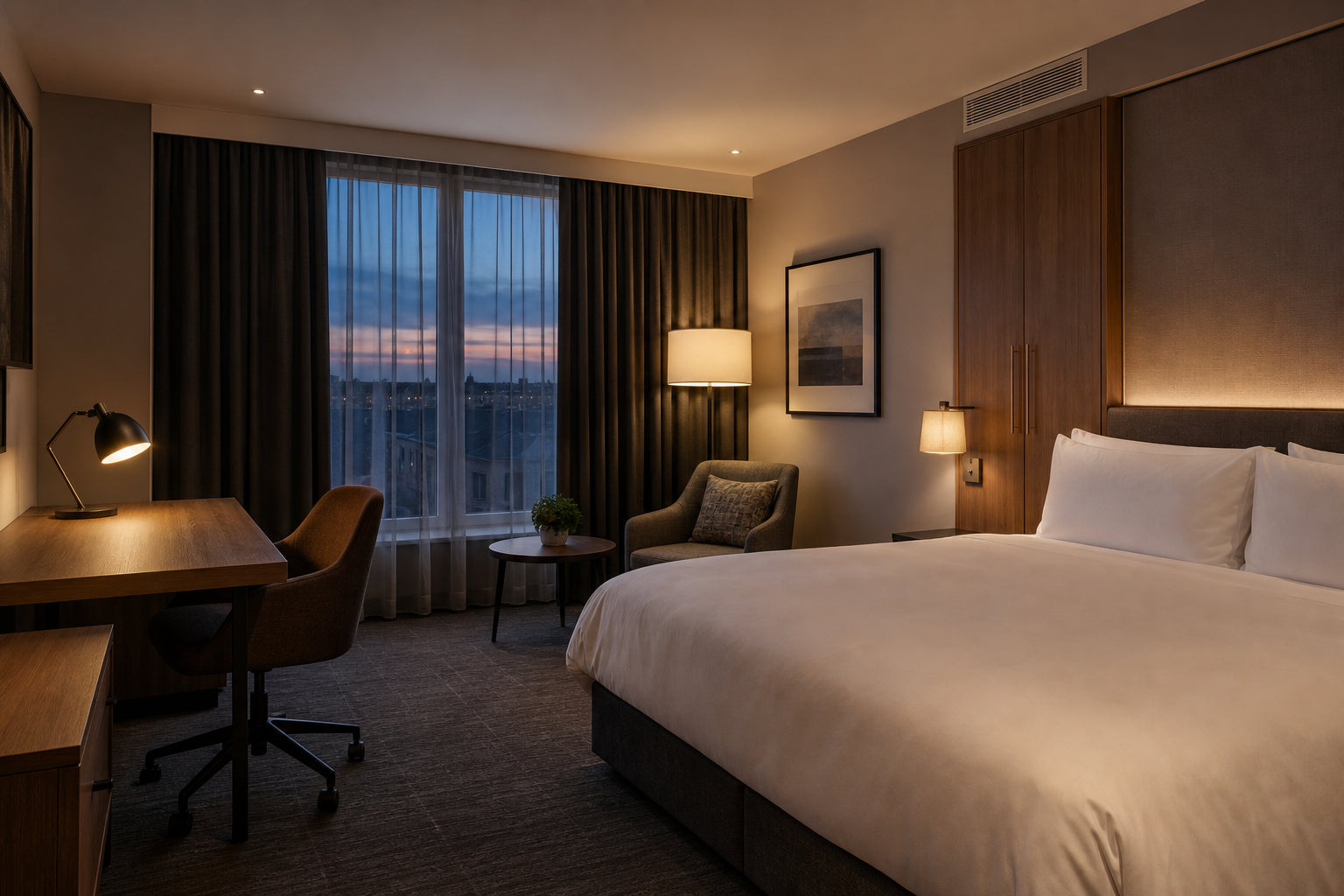
A guest room is a bedroom, an office, a dressing room and a lounge, often within a single hour. One ceiling light cannot serve all of those jobs, which is why the working principle of guest room lighting is layering: several independent sources, each doing one job well.
- Ambient light sets the overall level — ceiling fittings or wall washers that make the room feel neither clinical nor dim on arrival.
- Task light serves work: a proper desk lamp that puts light on the surface, not in the guest's eyes, bright enough for reading documents in the evening.
- Bedside light is the most personal layer. Each side of the bed needs its own switchable lamp, so one guest can read while the other sleeps. A shared switch across the bed is a nightly argument built into the wall.
- Bathroom and mirror light must be honest and even at the mirror — shadows under the eyes from a badly placed downlight are noticed every morning — while remaining soft enough not to assault a guest at 3 a.m.
- Accent and wayfinding light is optional but powerful: a low-level night light or motion-activated glow between bed and bathroom prevents the midnight furniture collision without waking anyone fully.
Warmth matters as much as placement. Warm-toned lamps in the sleeping and lounging layers read as comfort; cooler, brighter light belongs at the desk and mirror where accuracy is the job. Mixing tones within a single layer — one warm bedside lamp and one cool one — is a small discord guests feel without identifying.
Controls guests can actually use
Sophisticated lighting fails at the switch. A guest arrives tired, in an unfamiliar room, often in the dark — and the controls must work for them within seconds, without a manual.
- Master control at the door and the bed. The two moments that matter most are walking in with luggage and turning in for the night. A switch by the door that brings the room to life, and a control at the bedside that shuts everything down without getting up, cover both.
- Label or make obvious. If a panel needs explanation, it is wrong. Guests will not experiment for long; they will simply leave lights on all night or sit in the dark, and neither is a good review.
- Every light reachable from somewhere sensible. The classic failure is the lamp that can only be switched off by crossing a dark room after getting into bed. Walk the room as a guest would, at night, and the flaws reveal themselves.
- Keep standby glow out of the sleep zone. Indicator LEDs on panels, TVs and appliances accumulate into a surprisingly bright room at night. Specify controls and equipment with dim or dark standby states wherever possible.
Blackout: the layer sleep depends on
Nothing in the lighting scheme matters more at 5 a.m. than the ability to keep light out. Guests crossing time zones, night-shift workers and anyone facing a summer sunrise judge the room on one question: does it go properly dark?
- True blackout linings, not merely thick fabric, with curtains generously overlapping the window on all sides.
- Close the gap in the middle — overlapping tracks or wands that let curtains meet fully. The bright vertical stripe at dawn is one of hospitality's most universal small failures.
- Mind the edges and the top. Pelmets or returns stop light leaking over and around the rail; side channels do the same for blinds.
- Audit at night, in the morning. Blackout can only honestly be checked at first light. Include it in room inspections rather than assuming the fit-out still performs as installed.
Ventilation and air quality: the invisible amenity
Air is the first thing a guest senses on opening the door, before the eyes take anything in. A room that smells fresh and neutral starts the stay on trust; a room that greets the guest with staleness, damp or last night's dinner starts it with doubt that no cushion arrangement can recover.
- Fresh air changes, reliably. Whether by openable windows, trickle vents or mechanical ventilation, the room needs a dependable route for stale air out and fresh air in — one that works with the window shut, because guests on busy streets will keep it shut.
- Bathroom extraction that actually extracts. The extractor fan is the hardest-working ventilation in the room, clearing steam after every shower. A weak or fluff-clogged fan means lingering humidity, misted mirrors, and eventually the mould spots that guests photograph. Cleaning and testing extract fans belongs on the planned-maintenance schedule, not the complaints log.
- Manage moisture at its sources. Showers, kettles, drying laundry over radiators — guest rooms generate more moisture than most domestic bedrooms. Good extraction, adequate background ventilation and surfaces that dry quickly keep it in check.
- Neutral is the target smell. Heavy air fresheners read as concealment. A properly ventilated, properly cleaned room smells of very little, and that is exactly what guests trust.
Temperature, control and quiet
Ventilation and heating or cooling are inseparable in the guest's experience: together they are simply "the air in the room". Three standards decide whether that experience is comfort or irritation.
- Give the guest real control. A thermostat or unit control that visibly responds — within sensible limits — matters almost as much as the temperature itself. Feeling trapped with someone else's setting is a complaint in the making.
- Quiet is part of the specification. A climate unit that clunks on and off, or a fan with a tick, will be blamed on "noise" in reviews without the guest ever identifying the source. The same discipline applies to every powered item in the room: this is why hospitality-grade silent minibars exist, and why compressor hum has no place within earshot of a pillow.
- Maintain seasonally, inspect continuously. Filters, grilles and units need scheduled cleaning; vents blocked by furniture or curtains need catching on inspection. A ventilation system is only as good as its least maintained room.
An operator's lighting and ventilation checklist
- Ambient, task and bedside layers all present and independently switched
- Bedside lamps controllable from each side of the bed separately
- Full shutdown possible from the bed; welcome light from the door
- Warm tones in sleep and lounge layers; accurate light at desk and mirror
- Blackout closes fully — no centre gap, no edge leak, checked at dawn
- Standby LEDs dimmed, repositioned or specified out of the sleep zone
- Fresh-air route works with windows closed
- Bathroom extractor tested and cleaned on schedule
- Room smells neutral on entry — no staleness, no masking fragrance
- Climate control responds to the guest and runs quietly
- All powered in-room equipment chosen for silent overnight operation
Comfort that never asks for credit
Lighting and ventilation succeed by disappearing. When both are right, the guest simply experiences a room that feels calm in the evening, dark at night, fresh in the morning and quiet throughout — and they attribute that feeling to the hotel as a whole. When either is wrong, no bedding upgrade compensates. For operators, the encouraging truth is that most of the failures are small and fixable: a lamp switch, a curtain overlap, a clogged fan, a humming appliance. Walk the rooms at night, fix what you feel, and the scores follow.
Roomwell supplies guest room equipment specified for exactly this kind of comfort — silent-running minibars and fridges, kettles, hair dryers and appliances built for quiet, dependable overnight operation. Browse the range in our Roomwell products collection, or contact our team to specify rooms that feel as good as they look.