

Ask a guest what they remember about a hotel room and they will mention the bed, the shower, perhaps the view. Ask them what they used, and the honest answer is a long list of small things: the hangers, the kettle tray, the bin, the ironing board, the glass by the sink, the luggage rack, the hair dryer in its bag. These accessories and supplies are the working surface of the guest room — the items guests actually touch, dozens of times per stay — and they are specified with far less care than they deserve.
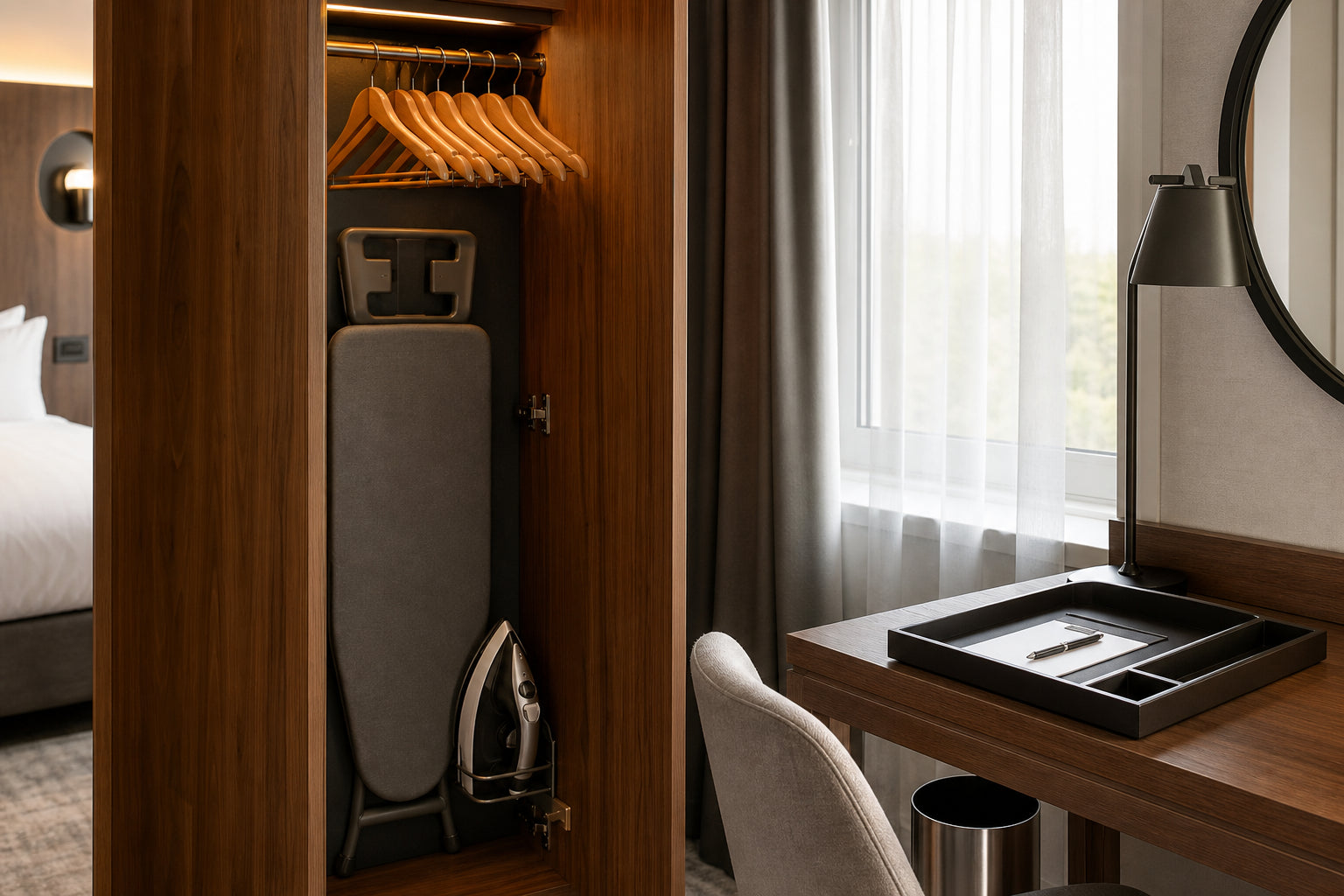
When the details are right, nobody notices, and that is the point. When they are wrong — three mismatched hangers, a wobbling ironing board, a bin with no liner — the guest notices immediately, and the room reads as tired regardless of how recently it was refurbished. This guide walks through the main categories of guest room accessories and supplies, what "good" looks like in each, and how to specify them so the standard survives daily commercial use across an entire estate.
Why the small items carry the standard
A guest room is judged by proxy. Guests cannot inspect the mattress core or the plumbing, so they read quality from the things in their hands. A solid wooden hanger says one thing about a property; a bent wire one says another. The same logic applies to every accessory in the room: each one is a small, tangible statement about how the property is run.
The accessories also do disproportionate operational work. Housekeeping interacts with every one of them on every turnover — counting, straightening, replacing, wiping. Items that are inconsistent, fragile or awkward to reset slow the clean and invite errors. Items that are standardised, durable and simple to present make the room quicker to turn and easier to audit. Specifying the details well is therefore not a cosmetic exercise; it is a housekeeping-productivity decision.
Finally, the small items are where standards drift first. Nobody replaces a bed with a cheaper one mid-cycle, but hangers, glasses, trays and bins get replaced piecemeal as they break or walk out of the door. Without a written specification and a standard product, a consistent estate becomes a patchwork within a year or two.
Wardrobe and clothing care
The wardrobe is one of the first things an arriving guest opens, and its contents set expectations for the rest of the stay.
- Hangers. Specify one matching set per room, in sufficient quantity for the room type — more for doubles and family rooms than singles. Include a mix of standard, trouser-bar and clipped hangers. Anti-theft hooks are a legitimate choice for some properties, but weigh the slightly less premium feel against the replacement cost you are avoiding.
- Ironing board and iron. A full-size board that stands firmly, a cover without scorch marks, and an iron with an intact soleplate and cord are the minimum. Wall-mounted holders or dedicated wardrobe storage keep the set tidy and make it obvious at a glance whether it is present. In hard-water areas, build iron descaling or replacement into the maintenance routine before guests find brown spotting on their shirts.
- Laundry bags and lists. If the property offers a laundry service, the bag and list should be present, clean and current. If it does not, remove them — an out-of-date form signals neglect.
- Luggage rack. A folding rack or fixed luggage bench spares the bedspread and the guest's back. Check straps and joints on inspection; a sagging rack is worse than none.
Desk, tray and refreshment supplies
The desk and hospitality area is the most-handled zone in the room after the bed. It rewards a disciplined, itemised specification.
- The hospitality tray. A wipeable tray that contains the kettle, cups and supplies keeps the surface tidy and gives housekeeping a defined footprint to reset. The kettle itself should be a hospitality-grade cordless model — quick to boil, stable on its base and easy to descale.
- Cups, glasses and spoons. Specify the count per room type and stick to one pattern across the estate so breakages can be replaced like-for-like. Glassware should be actual glass or high-quality alternatives appropriate to the tier; a plastic tumbler in a premium room undoes a great deal of other spending.
- Consumables. Tea, coffee, sugar and milk portions, presented in a defined arrangement with defined par levels. The arrangement matters as much as the contents: a standard layout is faster to restock and instantly reveals what is missing.
- Stationery. Keep it minimal and current — a notepad and pen still earn their place; a folder of photocopied menus generally does not. Whatever is specified should be clean and complete, because a chewed pen or a half-used pad reads worse than nothing.
Bins, bathroom accessories and the unglamorous essentials
Nobody chooses a hotel for its bins, but few items are handled more often — by guests and housekeeping alike — and few betray a weak specification faster.
- Room and bathroom bins. Specify solid, easily cleaned bins with removable liners or inner buckets, sized to realistic waste volumes. Pedal or soft-close options suit bathrooms; open bins are acceptable at the desk. Whatever the choice, every room should have the same models in the same positions.
- Hair dryer. A hospitality-grade dryer, stored in a defined place — a bag, drawer or wall holster — and checked at turnover for cable condition and filter fluff. Guests notice a feeble or noisy dryer immediately, and it is one of the most commonly reported "missing" items when storage is inconsistent.
- Bathroom counter accessories. Tumblers, tissue-box covers, soap dishes or dispenser brackets should match, be intact and be genuinely clean. Anything chipped or clouded should be swapped at the clean, not at the complaint.
- Safe. Where fitted, the in-room safe should be open, working and demonstrably reset from the previous guest. A safe with a dead battery is worse than no safe at all, because it fails the guest at the exact moment they placed trust in it.
Specifying for durability and consistency
The difference between a domestic accessory and a hospitality one is not the look; it is the duty cycle. An item that survives a household's weekly use may fail in weeks under daily commercial handling and industrial cleaning chemicals. Specifying well means buying for the environment, not the photograph.
Practical rules that keep an accessories specification honest:
- Write it down, per room type. An itemised list — product, quantity, position — turns "the room looks right" into something a housekeeper or auditor can check in two minutes.
- Standardise across the estate. One hanger, one bin, one kettle, one dryer. Standardisation simplifies spares, training and like-for-like replacement, and it is the only way multi-site consistency survives staff turnover.
- Buy replacements with the original order. Attrition on small items is certain — breakage, wear and the occasional souvenir hunter. Holding stock of the standard item prevents the mismatched drift that makes rooms look tired.
- Choose cleanable over precious. Every surface in the specification will be wiped thousands of times. Finishes that mark, fabrics that stain and crevices that trap dust all create work and shorten life.
- Review annually, not reactively. A yearly walk-through of the specification — what is failing, what guests ask for, what housekeeping curses — keeps the list current without constant churn.
An operator's quick checklist
Use this as a starting point when auditing or rewriting your accessories and supplies standard:
- Matching hangers in the specified quantity, correct mix of types
- Ironing board stable, cover clean, iron soleplate unmarked and descaled
- Luggage rack present and sound
- Hospitality tray complete to the defined layout and par levels
- Kettle clean inside, seated firmly, boiling promptly
- Cups, glasses and spoons to count, matching, unchipped
- Bins in position, clean, lined where specified
- Hair dryer present in its defined home, cable and filter checked
- Safe open, powered and reset
- Stationery current, clean and complete — or deliberately absent
None of these items is expensive. All of them are visible. Together they are the difference between a room that feels managed and a room that feels merely furnished.
The details are the standard
Guest room accessories and supplies are where brand standards either live or quietly die. They are handled by every guest, reset at every turnover and replaced piecemeal unless someone owns the specification. Treating them as a deliberate, written, standardised part of the room — rather than a drawer of leftovers — costs little and pays back in faster housekeeping, cleaner audits and rooms that feel consistently cared for.
Quick answer: The bed and the bathroom get the attention, but it is the accessories — hangers, trays, bins, ironing kit, glassware — that guests actually handle. Here is how to specify the details to a standard that holds up across an estate.
Benefits
- Consistent cleaning standards protect brand reputation.
- Clear checklists reduce missed amenities and rework.
- Faster room turns improve occupancy flexibility.
- Inspection discipline catches appliance and safety issues early.
Features
- Room-ready checklists covering bathroom, bed, tray and appliances.
- Standards for VIP vs standard resets.
- Maintenance escalation paths for broken kit.
- Training cues that keep every room on-brand.
Frequently asked questions
What should a guest-room inspection always include?
Bathroom spotlessness, bed presentation, hospitality tray, working appliances, safe reset and overall odour/noise readiness.
How do hotels keep standards consistent across staff?
Written checklists, sample rooms, and random inspections — not memory alone.
Why do missing amenities keep recurring?
Usually reset discipline, not purchasing. Standard kits and clear wardrobe layouts help.
Should VIP rooms use a different checklist?
Yes — same foundations plus welcome readiness, preferences and higher presentation detail.
Roomwell supplies the hard-working accessories behind the standard — kettles and hospitality trays, hair dryers, safes, ironing equipment and bins — chosen for durability under daily hotel use and consistent presentation across an estate. Browse the range in our Roomwell products collection, or contact our team to build an accessories specification that holds up in every room, every night.