

Ask guests to describe great service and they will usually tell you about a person — a warm welcome, a problem solved, a name remembered. But look closely at how guests actually score their stays and a quieter truth emerges: much of what they experience as "service" happens when nobody from the hotel is in the room at all. The bed that lets them sleep, the kettle that boils quickly, the hair dryer that actually dries hair, the socket beside the bed — these are service, delivered in advance, through the room itself.
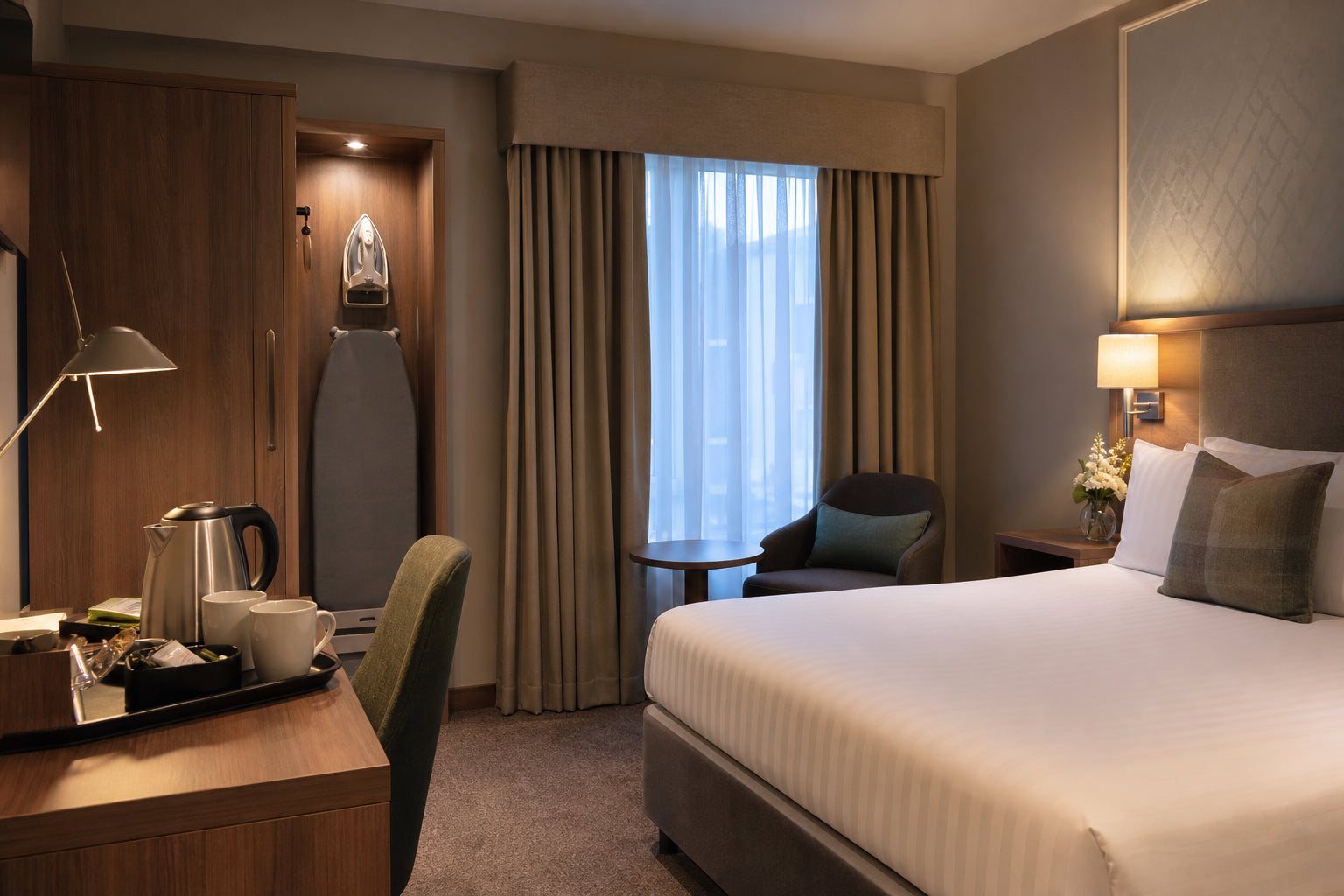
For UK operators, this is both a challenge and an opportunity. The challenge is that in-room comfort failures are invisible to the team until they surface as a complaint or a review. The opportunity is that the guest room is the one part of the service experience you can fully standardise, audit and control. This article looks at how comfort and service quality connect inside the room, and what operators can do — practically and affordably — to make every room deliver.
Comfort is service, delivered in advance
A guest's sense of being looked after does not begin when they call reception. It begins when they walk into a room and find that everything they need is already there, working, clean and easy to use. In that sense, every specification decision — which kettle, which mattress topper, which bedside lighting — is a service decision made months before the guest arrives.
This framing matters because it changes who owns comfort. It is not just housekeeping's job to present the room well; it is procurement's job to choose items that perform, maintenance's job to keep them performing, and management's job to set a standard that holds across every room. When a guest writes "the room felt tired" or "everything just worked," they are reviewing all of those decisions at once.
The most useful mental test is simple: walk into one of your own rooms as if you had just arrived off a delayed train at 9pm. What do you reach for first? Does it work first time? Every point of friction you find is a service failure waiting to be reviewed — and every smooth interaction is service quality you delivered without a single staff hour.
The touchpoints guests actually judge
Guests do not experience a room as a list of fixtures. They experience it as a sequence of small interactions, and a handful of touchpoints carry most of the weight:
- The bed and bedding. Sleep quality is the single biggest driver of how a guest remembers a room. Mattress condition, protection, topper and pillow options matter more than almost anything else in the space.
- The hospitality tray. The kettle is often the first appliance a guest uses. A fast boil, clean interior and properly stocked tray read as care; limescale and missing milk read as neglect.
- The bathroom. Water pressure, towel quality and a hair dryer with genuine power are judged within the first hour of a stay.
- Lighting and power. Guests want to control light from the bed and charge devices beside it. Rooms that make this hard feel dated regardless of the decor.
- Climate and quiet. A room that is too warm, too cold or too noisy undoes everything else. A working fan in summer is one of the most review-protective items a UK hotel can own.
- Storage and practical kit. Luggage racks, hangers that come off the rail, an iron and ironing board in usable condition, a safe that works first time — these tell business travellers in particular that the room was designed for real use.
Notice that almost none of these are luxury items. They are ordinary things, judged on whether they work. That is the essence of in-room service quality: reliability, presented well.
Consistency: the difference between a good room and a good hotel
A single excellent room proves very little. Guests book the hotel, not room 204, and their loyalty depends on getting the same experience whichever key they are handed. This is why consistency is the operational heart of service quality — and why it is worth standardising the in-room offer deliberately rather than letting it drift as items are replaced piecemeal.
Standardisation pays back in several ways at once:
- Housekeeping speed and accuracy. When every room carries the same kettle, the same tray layout and the same amenity set, room turnover becomes a repeatable routine rather than a series of judgement calls.
- Simpler auditing. Supervisors can check a room against a single known standard instead of remembering what each room is supposed to contain.
- Easier maintenance and spares. One model of hair dryer across the estate means one set of spares, one replacement process and no guest ever getting the "worst" unit.
- A coherent brand impression. Matched finishes and consistent presentation make even a modest room feel intentional.
Drift is the enemy here. It rarely happens by decision; it happens when a broken kettle is replaced with whatever was available that week. Over a few years, an estate quietly accumulates five kettle models, three kinds of hangers and an unpredictable amenity offer. Setting a written room standard — and buying against it — is the fix, and it costs discipline rather than money. Our guest-room collections are organised to make this kind of estate-wide standardisation straightforward.
When the room fails, the front desk pays
Every in-room failure has a second cost that rarely appears on a spreadsheet: it converts a self-service moment into a staffed one. The guest who finds no iron in the wardrobe calls reception. The guest whose kettle will not boil wants a replacement brought up. The guest whose safe will not open needs someone with an override — now, because their passport is inside and their taxi is outside.
Each of these calls consumes staff time, interrupts other work and, crucially, starts the interaction on the back foot. The team member is no longer delivering service; they are recovering from a failure. Even when recovery is handled brilliantly, research and common sense agree on the basic point: it is better for the thing to have worked in the first place.
Operators can make this visible by tracking in-room requests and faults for a month. The pattern is usually stark: a small number of item categories — kettles, hair dryers, remote controls, irons, missing tray stock — generate a large share of the calls. Fixing those categories at the specification and inspection level is one of the highest-leverage service improvements available, because it removes the failure rather than speeding up the apology.
Practical standards that lift perceived quality
Raising in-room service quality does not require a refurbishment. Most of the gains come from specifying honestly for hotel use, and then protecting that specification with routine. A practical baseline for UK operators looks like this:
- Specify for commercial use, not domestic. A guest-room appliance works many times harder than its household equivalent. Choose kettles, hair dryers and irons built for repeated daily use, and expect them to last accordingly.
- Write the room standard down. One page per room type: every item, its placement, and its condition standard. If it is not written, it will drift.
- Build checks into turnover. A ten-second test of the kettle, hair dryer and bedside lamp at each clean catches faults before guests do.
- Descale and maintain on a schedule. UK water is often hard. Limescale in kettles and irons is a taste, appearance and lifespan problem — deal with it on a rota, not on complaint.
- Keep a small float of replacements. A shelf of ready-to-go kettles, dryers and remotes turns a guest-facing failure into a two-minute swap.
- Review the standard annually. Guest expectations move — bedside charging, better lighting, quieter appliances. A yearly review keeps the standard current without constant tinkering.
None of this is glamorous, and that is rather the point. Perceived quality in a guest room is the accumulation of unglamorous things done consistently.
The room is your most reliable member of staff
People deliver moments of service; the room delivers hours of it. Between check-in and check-out, the space itself is host, concierge and housekeeper — offering a drink, a good night's sleep, a hot shower and a pressed shirt without a single interruption. Treating the room as an active part of the service team, rather than a container for it, is the mindset shift that separates hotels guests praise from hotels guests merely tolerate.
The good news for operators is that this is one of the most controllable levers in hospitality. You cannot script every human interaction, but you can absolutely guarantee that every kettle boils, every hair dryer dries and every tray is stocked. Do that, estate-wide, and your reviews will start reflecting a level of "service" that your rota never had to cover.
Quick answer: Service quality is not only what happens at the front desk. It is built, detail by detail, inside the guest room — from the bed and the lighting to the kettle, the hair dryer and the safe. Here is how UK operators can turn the room itself into their most reliable service tool.
Benefits
- Consistent cleaning standards protect brand reputation.
- Clear checklists reduce missed amenities and rework.
- Faster room turns improve occupancy flexibility.
- Inspection discipline catches appliance and safety issues early.
Features
- Room-ready checklists covering bathroom, bed, tray and appliances.
- Standards for VIP vs standard resets.
- Maintenance escalation paths for broken kit.
- Training cues that keep every room on-brand.
Frequently asked questions
What should a guest-room inspection always include?
Bathroom spotlessness, bed presentation, hospitality tray, working appliances, safe reset and overall odour/noise readiness.
How do hotels keep standards consistent across staff?
Written checklists, sample rooms, and random inspections — not memory alone.
Why do missing amenities keep recurring?
Usually reset discipline, not purchasing. Standard kits and clear wardrobe layouts help.
Should VIP rooms use a different checklist?
Yes — same foundations plus welcome readiness, preferences and higher presentation detail.
Roomwell supplies guest-room appliances and amenities to hotels across the UK, specified for reliability and consistent presentation across whole estates. Browse our guest-room collections, or contact our team to build a room standard that delivers comfort and service quality in every room, every night.