

Ask ten guests to define a luxury hotel room and you will get ten vague answers — "it just feels special" being the most common. Ask the operators who build those rooms, and the answers become strikingly concrete. Luxury, from the inside, is not a mood. It is a set of factors, each of which can be named, specified, budgeted and inspected.
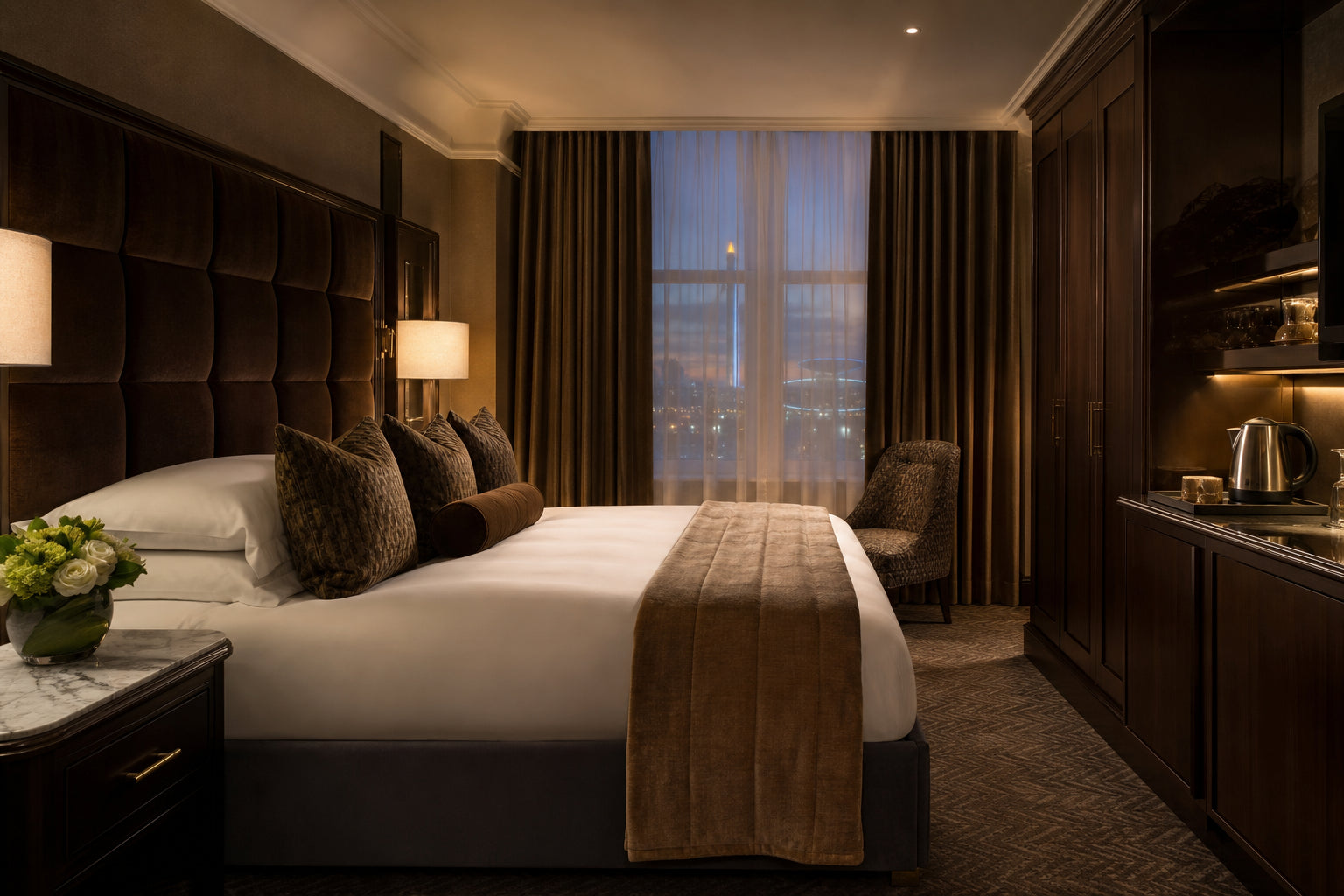
That is good news for anyone responsible for rooms, because it means luxury is buildable — and partially buildable at almost any price point. This article breaks the "special feeling" into its working parts: sensory quality, effortlessness, completeness, quiet, and detail, and looks at how each is actually created.
Factor one: sensory quality at every contact point
Luxury is experienced through the body before it is judged by the mind. Every point where the guest's skin, hands or feet meet the room is a place where luxury is either created or contradicted: the linen against the face, the carpet underfoot, the weight of the kettle in the hand, the temperature of the bathroom floor, the resistance of a drawer as it closes.
The operational insight is that these contact points are a finite, listable set. Luxury properties audit them deliberately:
- Bedding that feels substantial and stays crisp through commercial laundering.
- Towels and robes with genuine weight rather than volume-driven thinness.
- Hardware — taps, handles, switches — that moves smoothly and feels solid.
- Appliances that operate with quality feedback: a kettle that seats positively, a safe whose door closes with a firm click, a hair dryer with real power rather than a token airflow.
Guests almost never articulate these sensations individually. They aggregate them into a single verdict — "quality" — which is precisely why every cheap-feeling touch point dilutes the whole.
Factor two: effortlessness
The second factor is harder to see because its success is invisible: in a genuinely luxurious room, nothing requires figuring out. The guest never hunts for a socket, never wrestles with an unfamiliar shower control, never searches for the ironing board, never wonders how to turn off the last light from bed.
Effortlessness is engineered through anticipation:
- Power where hands reach — both bedsides, the desk, beside the mirror — without cables trailing across the floor.
- Controls that explain themselves — lighting and climate a first-time guest operates correctly on the first attempt.
- Amenities staged at their point of use — the hair dryer by the mirror, the kettle beside water and cups, the safe at a height that does not require kneeling.
- Storage that anticipates the stay — luggage bench, hanging space, drawers that are actually empty and clean.
Every moment of friction removed is a moment the guest never experiences — and the accumulation of absent frustrations is a large part of what "relaxing" physically means.
Factor three: completeness
Luxury collapses instantly when something is missing. A beautiful room without a working kettle, or with a minibar that was never restocked, does not read as "beautiful with one flaw" — it reads as a broken promise. Completeness is therefore a genuine luxury factor in its own right: everything the guest could reasonably need is present, functional and matched to the room's standard.
In practice, completeness is delivered by specification and discipline rather than inspiration. A written amenity standard per room type — tea and coffee service, minibar, safe, hair dryer, iron and board, robes, bins, hangers, spare bedding — restocked and function-checked at every turnover, is what guarantees the factor survives a full house and a new starter on the housekeeping team. Operators building that specification can draw the appliance layer from the Roomwell products collection, where equipment is selected for exactly this kind of estate-wide reliability.
Factor four: quiet
Of all the factors, quiet is the one guests pay for most directly and notice least consciously. Deep, uninterrupted sleep is arguably the core product of a luxury room, and it is produced by an accumulation of acoustic decisions: the door that closes softly on a damped hinge, genuine blackout, corridor discipline — and, critically, the noise behaviour of the room's own equipment.
The refrigeration hum of a compressor minibar is the classic self-inflicted wound; silent absorption minibars exist precisely because luxury operators refused to trade sleep for cold drinks. The same scrutiny applies to air conditioning units, bathroom extractor fans and even the click of a kettle switching off. A room can be furnished impeccably and still fail the luxury test at 3 a.m. — which is why quiet belongs on the specification sheet, not in the hope column.
Factor five: detail as evidence of care
The final factor is the one guests photograph: the turndown touch, the aligned amenities, the fold of the towel, the handwritten note. These details matter not for themselves but for what they prove — that someone attended to this room, this guest, this stay. Detail is care made visible.
The operational caution is that detail only works on top of the other four factors. A towel folded into a swan cannot rescue a noisy fridge or a missing kettle; in fact, decorative detail over functional failure actively irritates, because it suggests the property's attention went to the wrong place. Luxury properties sequence their effort accordingly: contact points, effortlessness, completeness and quiet first — flourish last.
What this means at different price points
Seen as factors rather than a mood, luxury becomes partially available to every tier of the market:
- Every property can deliver completeness and much of effortlessness — they cost discipline, not capital.
- Most properties can buy meaningful quiet: silent minibars, softer door hardware, better housekeeping timing.
- Sensory quality scales with budget, but concentrating spend on the highest-contact items — bed, towels, kettle, hair dryer — buys the most feeling per pound.
- Detail is nearly free, provided the foundations beneath it are sound.
The properties guests describe as "surprisingly lovely for the price" are almost always the ones that understood this arithmetic: they could not afford everything, so they bought the factors that guests feel.
Building luxury deliberately
Luxury in a hotel room is the sum of decisions — about what guests touch, what they never have to think about, what is always present, what they never hear, and what quietly proves someone cared. Each factor can be specified, and each specification can be held through turnover after turnover. That is the entire trick, and it is available to any operator willing to work through it deliberately.
Quick answer: Luxury is not an accident of budget — it is the sum of identifiable factors: sensory quality, effortlessness, completeness, quiet and detail. Here is how each one is built into a hotel room.
Benefits
- Thoughtful amenities convert arrival into a personal welcome.
- Tiered amenities control cost while protecting VIP impact.
- In-room essentials reduce requests and friction.
- Consistent presentation supports brand photography and reviews.
Features
- Core kit: tray, dryer, safe, towels and toiletries.
- Optional VIP layers: welcome notes, local produce, upgraded consumables.
- Room-readiness checks before amenity placement.
- Allergy-aware and preference-aware delivery rules.
Frequently asked questions
What is a welcome amenity really for?
To show the guest they were expected — personalisation and timing matter more than cost.
Should every VIP get the same amenity?
No. Tier by occasion, loyalty and value so generosity stays sustainable.
What room conditions must be ready before amenities?
Clean bathroom, made bed, working appliances, chilled/clean fridge or minibar, and correct temperature/lighting.
Which amenities are now considered baseline?
Wi-Fi, kettle tray, hair dryer, towels and a clean bathroom kit in most UK hotels.
Roomwell supplies UK hotels with the equipment side of the luxury equation — quiet minibars, quality kettles, powerful hair dryers, solid safes and ironing equipment specified for hospitality use. Explore the Roomwell range, or contact our team to build the factors into your rooms.