

Strip away everything else and a hotel sells one thing: a good night's sleep. Guests may book for the location, the restaurant or the meeting rooms, but they review the bed. It is the single item in the room they spend the most hours in contact with, and it is judged with the whole body rather than a glance. A room can carry a dated bathroom or a small desk far more easily than it can carry a tired mattress or grey-washed linen.
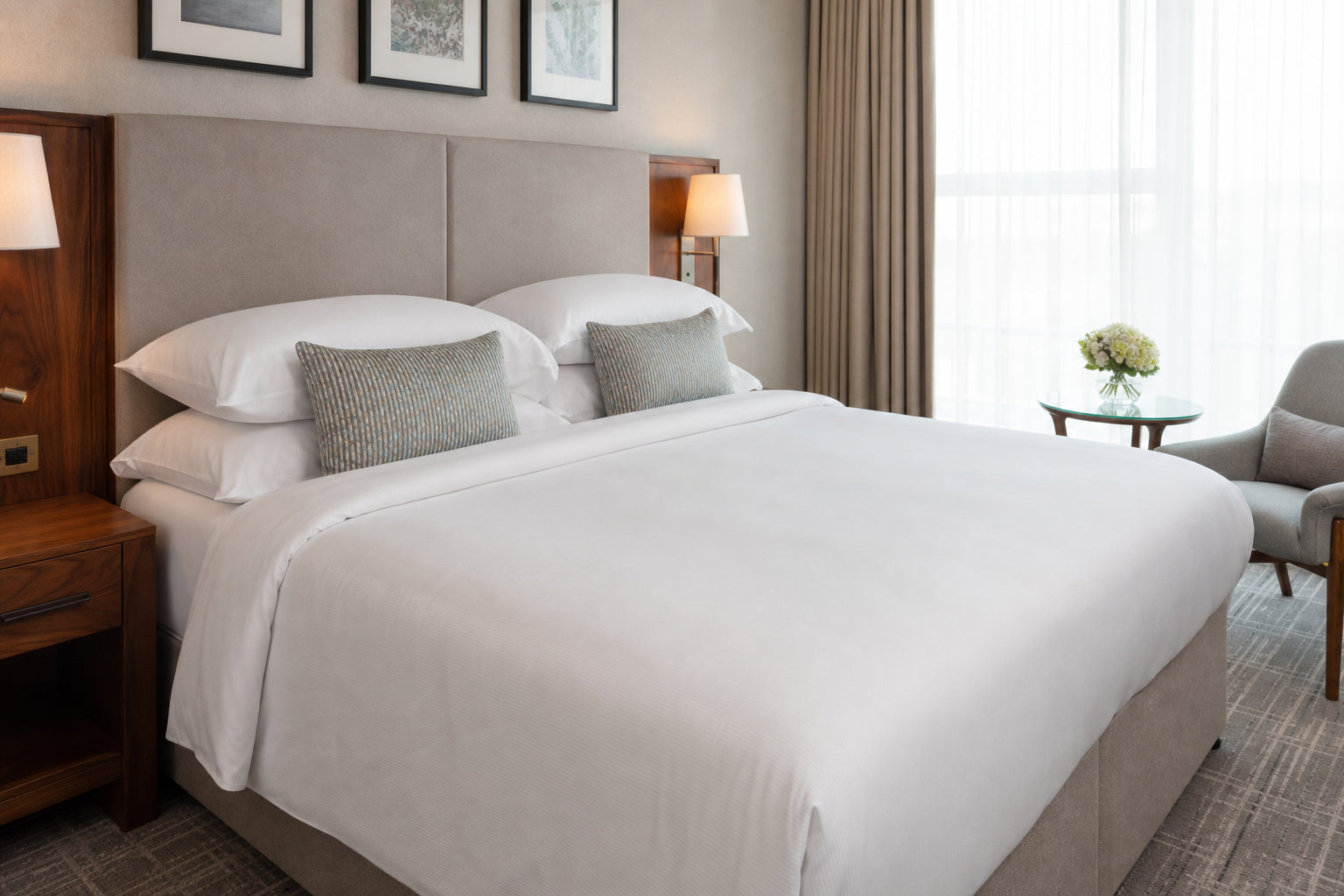
That makes bed types and bedding standards a commercial subject, not just a housekeeping one. The configurations you offer determine which guests you can sell to; the mattress and linen standard determines whether they come back. This guide works through the decisions in order — bed types, mattress quality, linen rotation, pillows, and the duvet-versus-blankets question — with a focus on what UK guests expect and what holds up operationally across an estate.
Bed types: matching configuration to demand
UK bed sizing has its own conventions, and getting the mix right across an estate is a revenue decision as much as a design one. The standard configurations, and where each earns its keep:
- Single. The compact workhorse of budget properties, crew accommodation and single-occupancy business stays. Its virtue is footprint: it fits rooms nothing else will. Its limit is that many solo travellers now expect a double, so singles suit properties where price or room size genuinely demands them.
- Twin. Two singles in one room — essential inventory for colleagues travelling together, friends, tour groups and some family setups. Twins sell to guests a double simply cannot, and properties that convert too much twin stock to doubles often discover the gap when group business arrives. Zip-and-link bases, which join two singles into a large double, offer the best of both where housekeeping can manage the changeover.
- Double. The default UK guest room bed and the baseline expectation for couples and most solo leisure travellers. It fits the majority of room footprints and remains the backbone of most estates.
- King and super king. The comfort upgrade guests increasingly expect as standard in premium rooms, and the size many now sleep on at home. Where the room can take it, a king is one of the most direct ways to justify a higher rate — but only if circulation space, bedside access and furniture proportions are adjusted with it. A king crammed into a double-sized room reads as cramped, not generous.
The operational rule: decide the configuration mix from your demand pattern — corporate versus leisure, couples versus groups — and then standardise sizes tightly within each room type, so linen, protectors, toppers and duvets can be stocked and rotated without a matrix of exceptions.
Mattress quality: the signals guests actually feel
Guests never see the inside of a mattress, but they feel its condition within minutes of lying down. A hotel mattress works far harder than a domestic one — different body weights every night, guests sitting on the edges, luggage and children treating it as furniture — so specification and lifecycle management matter more than any single feature on a datasheet.
The quality signals worth specifying for:
- Support without noise. A contract-grade sprung or hybrid construction that supports a wide range of body weights, with no creak or movement transfer — a real concern in twin-share and couple occupancy.
- Edge support. Hotel mattresses are sat on constantly. Reinforced edges keep the sleeping surface flat for years longer and stop the tell-tale rolled shoulder guests read instantly as "old mattress."
- Turnable or rotatable design. A mattress that can be rotated (and turned, where the construction allows) on a housekeeping schedule wears evenly instead of dishing in the centre. Put the rotation on the deep-clean rota, not on memory.
- Fire safety compliance. Contract mattresses must meet the fire-safety standards applicable to hospitality use, which are stricter than domestic requirements. This is non-negotiable at specification stage.
- Protection from day one. A quality washable protector — waterproof where the property's risk profile calls for it — is the cheapest life-extension a mattress can get, and it keeps hygiene inspectable at every linen change.
Equally important is knowing when a mattress is finished. Visible dips, staining through the protector, audible springs and guest comments about backache are all end-of-life signals. An asset register with purchase dates per room turns replacement into a planned annual budget line rather than a scramble after a bad review.
Linen standards and rotation: whiteness is a system
Crisp white linen is the near-universal UK hotel standard for good reason: it signals cleanliness unambiguously, it can be washed at temperatures that keep it hygienic, and it never clashes with a scheme. But whiteness that survives commercial laundering is a system, not a purchase.
- Specify for the laundry, not the showroom. Linen must tolerate frequent high-temperature commercial washing without greying, thinning or losing shape. A plush domestic set that fails after limited washes costs more per use than a proper contract weave.
- Run three sets (par) per bed as a working baseline. One on the bed, one in the laundry, one on the shelf. Estates running below this level find themselves putting damp or damaged linen back into service under pressure — which guests notice.
- Rotate stock strictly. First in, first out. Without rotation, some sets wash fifty times while others wash five, and the estate ends up with visibly mismatched whites on the same bed.
- Condemn without sentiment. Thin patches, permanent staining, fraying hems and greying beyond recovery are removal triggers. A written condemning standard — with someone empowered to apply it — protects the bed from the worst set in the cupboard.
- Change between every stay, always. Full linen change on departure is the baseline UK guests assume. Mid-stay change policy is the operator's choice to define and communicate; the departure change is not.
Pillows: the most personal item in the room
No single pillow suits every guest, which is why the pillow is the most complained-about comfort item in hotels that only offer one option. The practical answer is layered provision rather than a search for the perfect pillow.
- Standard dressing of two pillows per sleeper — commonly one firmer and one softer — covers the majority of preferences without any request being made.
- A pillow menu or on-request options lift the standard further at modest cost: a firm supportive option for side sleepers, a soft low-profile option for front sleepers, and a hypoallergenic microfibre alternative for guests who cannot use feather or down. Even a small on-request range converts a complaint into a service moment.
- Fill choice is an operational decision. Natural fills feel premium but need conscientious laundering and allergy alternatives on hand; quality microfibre and hollowfibre fills wash easily, dry quickly and hold their loft through commercial laundering — which is why they dominate mid-market specification.
- Protect and retire on schedule. Every pillow should wear a washable protector under its case, and pillows should be washed and replaced on a defined cycle rather than kept until flat. A pillow that has lost its loft undermines the best mattress in the estate.
Duvets versus blankets: what UK guests expect now
The duvet has effectively won this argument in the UK market. A plump duvet in a crisp white cover is what the overwhelming majority of domestic guests sleep under at home and expect to find in a hotel; traditional sheets-and-blankets dressing now reads as dated to most UK travellers outside deliberately classic or heritage positioning.
That said, the choice still carries operational detail worth getting right:
- Weight strategy. Guest rooms run warm and guests differ. A mid-weight duvet suits year-round use in most centrally heated properties; estates in variable climates or with strong seasonal swings can hold a lighter summer option. Whatever the choice, standardise it per room type so housekeeping is never guessing.
- Washability. Duvets and covers must be specified to survive commercial laundering, with duvets themselves laundered on a defined cycle — not only when visibly soiled.
- Blankets still have a job. A spare blanket or quality throw in the wardrobe answers the cold-sleeper request instantly and stays on the housekeeping checklist, not in a storeroom. Layered toppers and runners can add the visual finish of traditional dressing without its stripping-and-remaking labour.
- Making time is money. Duvet dressing is materially faster at turnover than blanket dressing — a real consideration multiplied across every room, every day. It is one of the quiet reasons the industry moved, and a reason to think carefully before moving back.
Writing it down: the bedding standard as a working document
Everything above only holds if it is written into a bedding standard that housekeeping, maintenance and purchasing all work from: bed sizes per room type, mattress specification and replacement triggers, protector and topper policy, linen par levels and condemning criteria, pillow dressing and menu, duvet weights and laundering cycles. Once written, the standard is auditable — supervisors can walk a room and check it against the document, new starters can be trained to it, and purchasing can buy to it rather than to whatever was ordered last time.
The bed may be the headline, but the room around it completes the night: blackout that actually blacks out, bedside power that works, a quiet minibar that does not hum through the small hours, and appliances that do not intrude on sleep. Roomwell supplies hospitality-grade guest room equipment to hotels across the UK, specified for the realities of daily commercial use. Browse the Roomwell products collection to see the in-room ranges, or contact our sales team to talk through equipping guest rooms to a consistent, defensible standard across your estate.
Quick answer: The bed is the product a hotel actually sells. From room-type configurations to mattress quality signals, linen rotation and the duvet question, here is how to set bedding standards that hold up night after night.
Benefits
- Sleep quality is the core product of every hotel stay.
- Better bedding reduces night disturbance and complaint volume.
- Pillow choice supports higher-tier differentiation.
- Crisp white presentation photographs and sells well.
Features
- Supportive mattresses and fresh, well-laundered linen.
- Pillow standards or menus matched to brand tier.
- Seasonal duvet weights where climate requires them.
- Housekeeping reset standards that keep beds inspection-ready.
Frequently asked questions
What bedding basics matter at every star level?
A supportive mattress, clean white linen and adequate pillows — before decorative layers.
When is a pillow menu worth it?
At higher tiers or long-stay products where preference choice is part of the promise.
How often should mattresses be reviewed?
On a planned lifecycle with spot checks after complaints about comfort or noise.
Can bedding upgrades lift mid-scale scores?
Yes — sleep is where value-seeking guests still expect excellence.