

Every traveller has an instinct for the difference between a 3-star and a 5-star hotel room, but ask them to define it and the answers get vague: "nicer," "fancier," "more expensive." The truth is more interesting and more useful — for guests deciding what to book, and for operators deciding what their rooms should promise. The difference is not that one tier is good and the other is not; a well-run 3-star property can deliver a genuinely excellent stay. The difference is in what each tier sets out to provide, and where it chooses to spend.
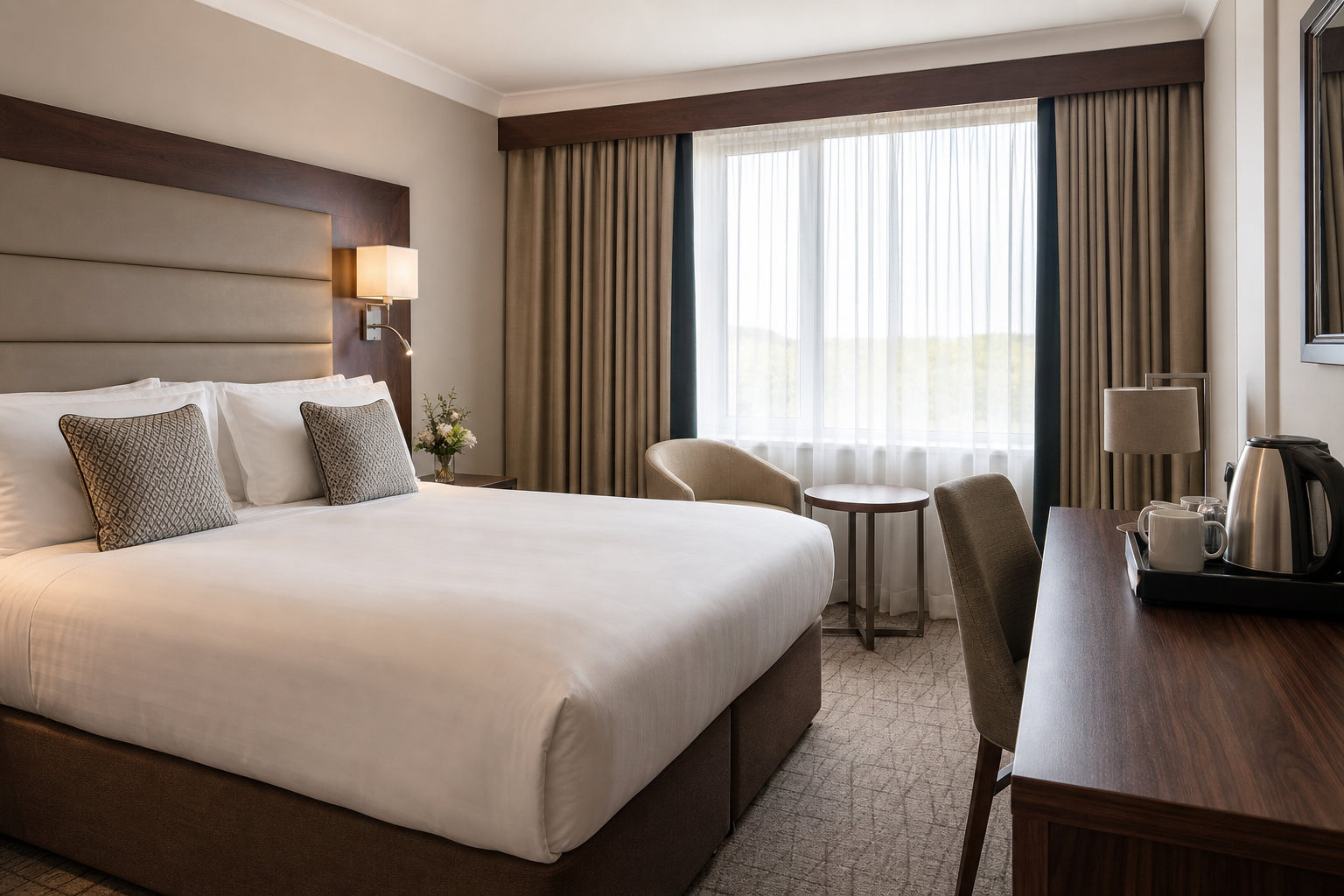
It is worth saying plainly that star ratings are awarded under specific schemes whose detailed criteria vary, and this article does not attempt to restate any scheme's rulebook. What it offers is a fair, practical comparison of what guests typically encounter at each level across six dimensions: space, service, amenities, the bathroom, the bed, and the in-room appliances.
Space and layout: room to sleep versus room to live
The most immediate difference is physical. A typical 3-star room is planned around the essentials — bed, wardrobe, desk, bathroom — arranged efficiently, sometimes tightly. It is a room to sleep, wash and work in, and a good one does all three comfortably.
A 5-star room is planned around living, not just sleeping. There is usually distinct space to sit that is not the bed: an armchair or sofa, a proper table, often a definable "zone" for working, lounging and dressing. Wardrobes are walk-in-adjacent rather than a rail behind a door; luggage has a home; two people can occupy the room at once without negotiating around each other. This space costs the operator real money on every square metre, which is a large part of what the rate difference buys.
The honest comparison: for a one-night business stop, the 3-star layout wastes nothing. For a multi-night stay, a special occasion or two people sharing, the extra space stops being a luxury and starts being the difference between a room and a residence.
Service: responsive versus anticipatory
Service at a good 3-star property is responsive: reception is helpful when asked, housekeeping is daily and thorough, problems are fixed when reported. Staffing levels are leaner, hours may be limited — the desk may not be staffed around the clock, and food service typically follows set hours.
Five-star service is anticipatory. The property aims to know what the guest wants before the guest asks: preferences recorded and acted on, 24-hour staffing as a matter of course, in-room dining through the night, concierge capability, and typically more staff per room by a wide margin. Turndown service, luggage handling and same-day pressing are standard expectations rather than extras.
Fairly stated: the 3-star model is not worse service, it is less service, deliberately, in exchange for a lower rate. Many guests neither need nor want to be anticipated. The 5-star premium pays for the staffing depth that makes anticipation possible — and that depth is invisible until the moment you need it at 3am.
Amenities: essentials versus abundance
In-room amenities show the tiers' philosophies clearly. The 3-star room provides the essentials done properly: tea and coffee tray, toiletries, towels, hangers, a television, reliable Wi-Fi. The 5-star room layers abundance and choice on top: fuller and finer toiletries, bathrobes and slippers, a pillow menu rather than a single pillow, a stocked minibar rather than an empty fridge, turndown touches, and often extras like fresh flowers or a welcome amenity.
The pattern is choice. At 3-star, the property has chosen for you, sensibly. At 5-star, you are offered options — of pillow, of drink, of when and how things happen. Choice is expensive to stock and to operate, which is why it clusters at the top of the market.
The bathroom: function versus experience
Bathrooms may be where the tiers diverge most visibly. The 3-star standard is a clean, functional en-suite: a good shower (often over a bath or in a compact enclosure), decent pressure and hot water, fresh towels, basic toiletries. When it is spotless and everything works, it does its job entirely.
The 5-star bathroom is built as an experience: more floor area, frequently a separate bath and walk-in shower, double basins in higher categories, underfloor heating, heated towel rails, magnifying mirrors, generous lighting designed for grooming rather than just visibility, and thick towels in quantities that assume two people and a swim. Stone and quality fittings replace laminate and standard sanitaryware.
The fair note for operators at both levels: guests forgive a small bathroom far more readily than a poorly maintained one. Sealant, drainage, pressure and spotlessness matter more to satisfaction at every tier than marble does.
Bedding: comfortable versus layered
A good night's sleep is the core product at both tiers, and a well-chosen 3-star bed — a quality mattress, fresh white linen, functional pillows — delivers it. Where the tiers differ is in depth and specification. Five-star bedding is layered: higher-specification mattresses and toppers, higher-quality linen with real weight, duvets in seasonal weights, a bank of pillows plus a menu of alternatives, throws and cushions that make the bed a piece of furniture as well as a place to sleep.
The difference is felt at the margins. Most sleepers do fine on the good 3-star bed. The guest with strong preferences — the side sleeper who needs a firm high pillow, the warm sleeper who wants a light duvet — is the guest for whom the 5-star bed is measurably better, because it offers choices rather than a single well-chosen default.
In-room appliances: the same categories, executed differently
Appliances are an instructive comparison because both tiers largely carry the same categories — kettle, hair dryer, safe, television, fridge or minibar, iron and board — and the difference is execution.
- Kettle and tray. Present at both tiers. The 3-star tray is functional; the 5-star tray adds finish — better cups, wider selection, sometimes an espresso machine alongside.
- Minibar. At 3-star, often an empty fridge for the guest's own use, or no fridge at all. At 5-star, a stocked, chilled, quiet minibar is expected — and silence matters, because a humming compressor undermines the sleep the rest of the room is built for.
- Hair dryer. Universal, but wattage and quality vary; the 5-star guest expects salon-level power, not a wall-mounted compromise.
- Safe. Increasingly standard at both tiers, sized for a laptop at the upper end.
- Iron and board. In the wardrobe at both tiers; condition and quality are what differ.
Here is the point operators at every level should take away: appliance reliability is tier-independent. A 3-star room with a fast kettle, a powerful hair dryer and a safe that opens first time beats a 5-star room where any of those fails. Specifying dependable, hotel-grade equipment — the sort of kettles, minibars, safes and hair dryers in Roomwell's guest-room collection — is one of the few investments that lifts guest satisfaction identically at both ends of the market.
So which is "better"? The honest answer
Neither, in the abstract. The 3-star room is an efficient, honest product: the essentials, done properly, at a rate that reflects exactly that. The 5-star room is a different product — space, staffing depth, choice and finish — at a rate that reflects all four. The failure mode at 3-star is cutting the essentials; the failure mode at 5-star is charging for anticipation and delivering only response. Guests are rarely disappointed by a tier; they are disappointed by a property that does not deliver what its tier promises.
Quick answer: The gap between a 3-star and a 5-star room is real, but it is not what most guests assume. A fair comparison of space, service, amenities, bathrooms, bedding and appliances.
Benefits
- Helps travellers match spend to how they will use the room.
- Gives operators a clearer investment map by quality level.
- Reduces expectation mismatches that drive poor reviews.
- Clarifies where appliances, bathrooms and service depth should differ.
Features
- 3-star focus: clean essentials, efficient layout, reliable kit.
- 5-star focus: space, anticipatory service, amenity choice and finish.
- Shared non-negotiables: sleep quality, bathroom cleanliness, working appliances.
- Practical decision cues for destination-led vs room-led trips.
Frequently asked questions
What is the real difference between 3-star and 5-star hotels?
3-star hotels sell essentials done well; 5-star hotels add living space, deeper staffing, richer amenities and higher finish.
Is a 3-star hotel good enough for vacation?
Yes when you prioritise location, cleanliness and sleep over suite space and anticipatory service.
Do star ratings mean the same everywhere?
No. Schemes differ by country — verify with recent reviews, not the badge alone.
Which features matter most at every star level?
Comfortable beds, spotless bathrooms, quiet nights and appliances that work first time.
For operators, the practical lesson sits in the overlap: whatever the star count on the plaque, the bed must be comfortable, the bathroom spotless, and every appliance in the room must simply work. Get that foundation right and the rest of the tier's promise has something to stand on.
Roomwell supplies reliable guest-room appliances and amenities to UK hotels at every level of the market — from efficient 3-star refurbishments to full 5-star specifications. Browse the range in our Roomwell products collection, or contact our team to match your in-room equipment to the standard your guests are paying for.